Shot in a quality not a step up from your standard digital camera, THE IGNORANT BLISS OF SUN AND MOON is a simple, direct idea, a statement in the form of a short film that, just as simply as it is made, is simply, good. The film follows a man who could easily be homeless, but, as we see later, in fact has a home. But he's the kind of person who's just a step away from homelessness: an alcoholic, screaming-at-the-heavens loser who gets into peoples shit and annoys, but who, as a person, evokes some sympathy. Like many a loser, the man begins to look for answers or hope from a greater power. In this film, its the sun and the moon, or, metaphorically, the overseers of his misery. Expecting such powers to understand, he seeks guidance, and upon rediscovering an old lottery ticket, buddhist-bullshit about letting your life be what it may be is sent down by the sun & moon's wisdom. But Hyams' protagonist is no idiot, and ends up winning thousands of dollars as he scratches the ticket. Like Hyams' other films, there's a strong sense of sympathy that follows his melancholy protagonist, which meshes well with the narration and wisdom of the sun and moon. But also apparent in Hyams' work is a gross reality, which rears its head when the man disregards supposed wisdom and experiences reality and specificity.
3/5 Stars
Showing posts with label 2010. Show all posts
Saturday, July 7, 2012
Monday, April 2, 2012
La Casa Muda
LA CASA MUDA is very close to SILENT HOUSE, except that it's awful. SILENT HOUSE was actually the American remake of this Uruguayan film, but it's surely an improvement. I don't go to a haunted house movie for story or plot, so in SILENT HOUSE, I was mainly led through a good experience by Elizabeth Olsen and cinematographer Igor Martinovíc. In LA CASA MUDA, the single take gimmick is poorly handled, and the story of Laura (Florencia Colucci) running about in a haunted house in the dark, is slow and pathetic. Not scary in the slightest bit, LA CASA MUDA has no sense of focus or interest, and lazily follows Laura about the house while maintaining a distance. She shrieks, and I have no sense where the film is. I yawn, she shrieks. What made the remake so entertaining is that Olsen-Martinovíc gave us a clear sense of where we were at every moment and what Olsen's character was experiencing at every moment. The range of emotions in LA CASA MUDA is scared and not scared, crying and not crying. A bore.
★★ out of Five
★★ out of Five
Monday, March 12, 2012
Steve
STEVE is a short film starring the radiant Keira Knightley, whose been gaining momentum for a bid at the Oscars this year with ANNA KARANINA, and Colin Firth, whose established himself as one of those A-list actors who is just about as charming as George Clooney. Neither of these talent actors, however, find anything much to work with in the nicely shot, but pretentiously understated and uneven short film. Instead there's just a lot of uneven tonality, and a couple of scenes with dialogue that's too vague to mean anything.
But like another film reviewed on here recently (ANOTHER EARTH), STEVE is just too timid to delve into anything that it suggests might be happening. Steve (Firth), a jittery downstairs neighbor comes up to bother a warring couple (Knightley and Tom Mison), and increasingly his complaints become more ridiculous or unhinged. But whatever is actually wrong with Steve, or how everyone chooses to deal with it is evidently up to the audience, which is a pretty poor cop-out device.
★ out of Five
But like another film reviewed on here recently (ANOTHER EARTH), STEVE is just too timid to delve into anything that it suggests might be happening. Steve (Firth), a jittery downstairs neighbor comes up to bother a warring couple (Knightley and Tom Mison), and increasingly his complaints become more ridiculous or unhinged. But whatever is actually wrong with Steve, or how everyone chooses to deal with it is evidently up to the audience, which is a pretty poor cop-out device.
★ out of Five
Wednesday, March 7, 2012
How to Train Your Dragon
I remember being wary of this film when it came out a couple of years ago. Dreamworks, the company that made this film, has never been a champion of animated films, and whenever I looked at their SHREK movies, I saw a descending quality. I would like to say that "Imagine my surprise, but HOW TO TRAIN YOUR DRAGON was just as good as everyone said it was", but I feel as if it were merely run of the mill, acceptable, but containing some of the major problems of animated films and children's films in general. The film is about a tribe (?) of vikings living on an island, who are incessantly at war with dragons. The whole point of life in the village seems to be to grow up strong so that you can kill dragons for glory. One viking however (now, how many kid's movies start like this?) is different. His name is Hiccup, he's the son of the clanleader, and he's gratingly voiced by Jay Baruchel, who has been disappearing from the public eye quicker and quicker, thank god. Hiccup works with the blacksmith, but is a village-wide failure of a viking. One day however, he sets off a cannon that ensnares the vicious, and previously unseen NightFury, a dragon whose flames never miss, and who has never been seen. Hiccup is overjoyed, and begins to pull down his knife to slay the dragon, but as he is in a Dreamworks animated movie, is completely unable to kill the dragon, befriends it, and changes everyone's mind about dragons. The thing that I found unappealing about the film is that the idea that these vikings and dragons have been killing each other for centuries is shied away from, for the film's tone is tepid. Worse though, is that this tone doesn't make me believe that that would be possible at all, and because of that, everything that happens in the film held no high stakes. Whenever a dragon shot its fire at someone, they brushed it off like they'd just shot ash at them. Especially in contrast to PRINCESS MONONOKE, there's nothing daring about this film. Sure, it's entertaining, but isn't it what we contrast good animated movies to when we're saying "Miyazaki's film was so much better because it didn't..." do exactly what HOW TO TRAIN YOUR DRAGON does.
★★ out of Five
★★ out of Five
Tuesday, January 31, 2012
Tiny Furniture
Unsure of its morals and its universality, but trenchantly personal, occasionally smart, and novel.
3 Stars out of 5
3 Stars out of 5
Trust
Despite an attempt to tackle a really serious issue, and despite some pretty good performances, TRUST falters because of abandoned plots and ideas, an overspecific villain, and reluctance to dig deeper.
Two Stars out of Five
Saturday, November 12, 2011
The Joneses
Odd for a film like THE JONESES to be so transparent and simplistic in its title, which refers to the saying 'keeping up with the Joneses'. So facile a title would not reflect some of the real fun that exists within the film, but such an idiotic title is also reflective on the downfall of the film, which is that its expectations for itself were never set very high. The story, which is, of course, ludicrous, is about a company which sets up fake families of people in rich neighborhoods who are given all the new, hottest stuff to parade about and force sales up. This fake family, consisting of the nymphomaniac Amber Heard as the daughter, David Duchovny as the inexperienced "father", Demi Moore as the weathered and ambitious "mother" and Ben Hollingsworth as the closeted "son". At first, Steve (Duchovny) is doing horrifically in his sales, and for a while the film tracks his struggle and unlikely ascent. Some of the methods the Joneses go through are pretty funny, and the odd humanity the "family" finds resembles that same good, buried movie. How the film fails though, is that it becomes so simplistic as to become stupid. It has a message of how we don't need to be keeping up with the Joneses, and a neighbor even kills himself because he has bought so intensely into their ideology. Steve Jones feels terribly, as if this is his fault, but there is no fault put on the idiots who buy in, and they are here excused. This then humanizes the Joneses, who are really just idiotic hogs who bask in their new shit and whine about how their lives aren't perfect. Such half-notions about 'money doesn't make you happy' and you can't 'keep up with the Joneses' is what makes this such a simplistic drag.
The Joneses: ★1/2
The Joneses: ★1/2
Sunday, October 23, 2011
Marwencol
At first, MARWENCOL looks like a sad but conventional trip through the life of Mark Hogancamp. Beaten brutally outside a bar in New York, Mark's brain was essentially altered after the beating. His lawyer tells us about the incident, and we see Mark as a severely damaged, retarded man. And then the film changes, and we learn that Mark was a real asshole, a drunk who probably started the fight (not to say that he deserved his punishment). He was a drawer in his old life, but this is a Mark Hogancamp who is now a different person, and reminisces on his old self (who he cannot remember) sadly, telling us that he doesn't even undestand such violence. He is however, a damaged person with fragmented memories and sad obsessions. In his first appartment after the incident, he pined after the woman next door (married and with two children). The woman and even her husband understand and pity Mark, but Mark sees the woman very clearly as something he probably knows he will never be able to have again. And then the film shifts. Mark, in order to deal with his personal tragedy, constructs a world in which he can live comfortably. He begins to collect action figure dolls, dresses them, names them after people he knows, and photographs them incessantly. He creates the town of Marwencol, with himself as a sturdy officer in a WWII town. He parades his figures (dead ringers for their real-life counterparts) around town on the road in a little jeep, he gives them all perfect detail. We see in Mark a man who has created a world that he can control, because he cannot control the world in reality. And then the film shifts. Mark is discovered by another photographer, and his work is put out into the open. Mark's images are beautiful and expressive, serious and non-comical works of his mind. MARWENCOL itself is a very good film about a very interesting subject. Although it is occasionally manipulative in its chosen paths, it is an interesting portrait of a man and his art.
Marwencol: ★★★1/2
Marwencol: ★★★1/2
Friday, October 14, 2011
The Walking Dead (S. 1)
"The Walking Dead" exists to further the idea that AMC creates great television. It's about zombie apocalypse, and, broken up into 44 minute episodes over the course of six episodes, different aspects about this apocalypse are explored. At the center of the series is policeman Rick Grimes, who was shot in the line of duty and sent into a coma. Grimes woke up post-onset, and made his way to a father and son who aid him. They tell him of Atlanta being a potential haven from the zombies, and he sets off for it, only to discover that is as overrun as the rest of the country. He meets up with a cast of characters including his old partner, his wife, son, and a group of refugees, and they slowly search for methods of survival. As mentioned earlier, the format of the show allows for different, interesting aspects to be explored. For one thing, there is no power in the world now, and without that, no government structure. With such realization though, as it is with many other apocalypse films, the idea that an eventual disintegration must take place sets it. This is grim and bleak, but well made. Unfortunately though, the subject is a dead-end, and many of the earlier plot developments are abandoned.
The Walking Dead: ★★1/2
Sunday, October 2, 2011
Breaking Bad (S.3)
Beginning poorly with a warped storyline and pretentious openings, season 3 of the usually fantastic "Breaking Bad" looked like it might be the ultimate decline of the show. However, after a slump at the beginning, "Breaking Bad" re-established itself, featuring some of its finest storylines and some excellent monologues. An entire episode consists of Walt and Jesse attempting to kill a pesky fly in a lab, loyalties shift, and characters become increasingly more complicated. Especially explored is the risks of Walt's lifestyle. Season three is still very good, and "Breaking Bad" is still one of the best shows on tv.
Breaking Bad (S.3): ★★★1/2
Wednesday, September 21, 2011
Buried
Unintentionally a response to Danny Boyle's 127 HOURS (this one features a severed finger, an enclosed space, a single character), the sadly trash-labelled Ryan Reynolds vessel BURIED is a cynical piece of good filmmaking with a bad message. The film opens to darkness, and then the flickers of a lighter (the first of many various ways to light the small space). Ryan Reynolds' clichéd, stubble infested face comes into view, and we learn that he is just a mere truck driver in Iraq, kidnapped after an attack, and buried alive in a coffin. Searching around, Reynolds' Paul Conroy discovers only a few small items to assist him: a zippo lighter and a blackberry. The blackberry miraculously (one of the films problems is miraculous circumstances) has power (only half of the battery left) and Paul begins to call various people who he thinks could assist him. this venture carries on for about half an hour, riveting in simultaneous realizations that a) we are riveted by a film that takes place with one character in the dark in a space about 3x6ft, and b) the ridiculous lengths that Paul has to go through to get help. Things start to happen though, and Paul is finally connected tot he voice of a hostage specialist. Spanish director Rodgrigo Cortés does a very good job at finding things to happen within his limitations, and the film is very well made. However, it suffers from a cynicism and a grim insistence to make bad things keep happening that is ugly in any film. Too many half-statements and fearful quasi-anti-americanisms hinder BURIED from being the anti-film to the overly distractive and extremely fearful 127 HOURS, but it is still entertaining and (for a very long time) very fun.
Buried: ★★★
Buried: ★★★
Monday, September 19, 2011
Devil
It sets itself up like a John Carpenter film from the 70's: building an odd cast, steely motions, and hidden violence in movement. Underneath an upturned world (perhaps too obvious a metaphor), and with a constant Christian superstitious undertone, a towering building in Philadelphia on a stormy day feeds some storytelling voiceover of a minor character. In this building, a few people attempt to enter an elevator. It's too full, and they wait for another, entering one by one until there are five. The elevator stalls, and the five are stuck together inside. This could work as some psychological play set-up, but the stormy skies and steely movements warn of a different tale. A security guard watching the events take place on camera tells us of the devil, who is a devious creature who doesn't give mercy. People start to get hurt inside of the elevator, and the police are called in, headed by a damaged detective. What is happening in the elevator is unknown, but we seem to know that one of the people inside is responsible for the events. Half detective story outside of the elevator, half ghost / slasher inside the elevator, DEVIL is a perfectly respectable, if not forgettable, piece of short, crisp, and problematic cinema.
Devil: ★★★
Devil: ★★★
Tuesday, September 6, 2011
Archer (S.1)
Archer is crass and vile, but it knows it. With a show that has nothing disingenuous about it, a show that knows that the gold ages of television have come and passed, a show that revels in its unimportance, it's hard not to love "Archer". Telling about the sexcapades of a momma's boy secret agent named Archer, the show consists of essentially spy-movie spoofs and gratuity. Drawn cleanly, the animation is still vaguely realistic, although occasionally choppy and pasty. But such an analysis does not even suit "Archer". Its genius relies not on its premise nor even its great characters (sex driven peons and sex driven agents who talk shit). Rather, "Archer" is a one-of-a-kind show because it knows dumb comedy well. It lets out a line, and then continually returns to that line, or situation later on in the show: contrasting its own "of the moment" hilarities with the ones from earlier. Archer himself, a Bondsian machine of insults, bad one liners, and sex stamina, acts as a tying force to many of the looser, lazier parts of the show. Occasionally shrill however, the first season suffers from a languor inherent to its type of comedy: essentially, hit or miss comedy. Despite this, this is a seemingly lazy effort from what must have taken a lot of work. This, however, is a perfect match to the kind of laziness required from television: as if the Kardashians were intentionally dipshits, rather than just actually being so.
Archer: ★★★1/2
Archer: ★★★1/2
Friday, September 2, 2011
Dexter (S.5)
The success of Showtime's "Dexter" must come from its supporting cast. Obviously, and occasionally, the storyline becomes over-ridiculous. Dexter, a serial killer vigilante type always played brilliantly by the talented Michael C. Hall, is too lucky in the show. So often, the cliffhangers at the ends of episodes are cleanly resolved at the beginnings of the next ones. To rectify this, as well as the formulaic design of each season, a specific twist is given to the supporting cast. Last season, John Lithgow provided an eerie presence, and this season, Julia Stiles provides one of the best characters of the entire series. Stiles plays Lumen Pierce, a damaged rape victim whom Dexter connects with. Here, Dexter's vigilante work is assisted by Lumen's desire for revenge. By this point in the series, we've bought Dexter's persona, but because that is always such a problematic one, Lumen's more-sellable revenge desire coasts us through. The show still has a lot of signature moments of great writing, Jennifer Carpenter is still a likeable contrast to Dexter, C.S. Lewis continues to be a source of boneheaded comic relief, and coming out of Dexter's wife's death in season 4, there's a very good handling of material. Season 5 seems destined to pale in comparison to the great season 4. But for this to be merely from contrast is unfair. Season 5 of "Dexter" is an exploration through already traveled waters, but still fun and suspenseful.
Dexter (Season 5): ★★★1/2
Sunday, August 14, 2011
Predators
Aliens with Dreadlocks Fight Reject Action Stars
Nimrod Antal is a good action director. That is clear from the beginning of PREDATORS, a quasi-sequel to the original PREDATOR and a quasi-stand alone film in the so-callled mythology. Thrusting us into the story by literally dropping us into an alien planet, Antal uses a brilliantly languorous opening of half-discoveries, established badass-ness, and the signature predator death rattle to give a great mood to his film. Adrien Brody, Alice Braga, Danny Trejo, and Topher Grace lead the cast of deadly killers who are dropped into the planet. It is eventually established that they are being hunted by the alien predators, and that they will all be picked off one by one until they're all dead. Apart from that being a given, because this is a monster movie in the 21st century, the sort of dignified structure is an odd way to start PREDATORS. Brody establishes himself as the leader of the pack, and just like in all the other predator and alien films, a few tactics are tried that don't work and leave extra characters dead, and a few tactics work that leave survivors undermined by the fact that no one's ever better off at the end of a disease/monster b-movie that they were to begin with. What's specifically frustrating about PREDATORS brand of 'everyone's fucked anyway' is that the potential exhibited in the direction of Antal doesn't deserve such a shoddy script filled with idiotic, wooden speech, and a killer that is frankly stupid and under-thoughtout. A few scenes here and there remind of the great beginning, but when the killer predators are self-admittedly unstoppable behemoths, the fact that they are so unbeatable makes the fate of the characters so pre-determined that the only fun that can be had is in deciding who lives and who dies (in order too). Essentially: boring. And a little gross.Predators: ★★
Sunday, July 3, 2011
Red Hill
Emerging from the small but strong Aussie cinema, RED HILL stands as an example of the current Australian practice, while also being quite a good film. Given the lack of cinematic strength in Australia up until the late 2000's, filmmakers like the Edgington's have slowly begun to cultivate the cinema. With films like ANIMAL KINGDOM or the excellent THE SQUARE, Australian filmmakers have revealed themselves to be extremely referential. THE SQUARE was very reminiscent of American noir, but it was unique in its own, dark way, and ANIMAL KINGDOM was reminiscent of American gangster films. RED HILL is more referential of old American westerns, and American horror films. Much of it is referencing this, but a lot of it relies on performance, delivery, and tone. The film stars "True Blood"'s Ryan Kwanten as a policeman who's moved to the outback with his pregnant wife for a more peaceful background. But when he goes off to work by foot, and meets an ornery group of inner-loyal cops, he senses something is awry. This is not a town that is specifically Aussie, but specifically of itself, encompassing a farm terror in the form of an escaped jaguar from a circus, and hidden truths beneath dirty faces. Kwanten is seen reading a book of baby boy names in his cop car, and receives a call of an escaped prisoner (a cop killer). This man moves through the town like NO COUNTRY FOR OLD MEN's Anton Chigurh: unstoppable. As the film progresses, Kwanten's cop discovers a hidden mystery involving much of the local populace, centered around the escaped prisoner. RED HILL is a fine thriller, knowledgable about where it wants to go with its story, and how it wants to burrow in.
Red Hill: ★★★1/2
Red Hill: ★★★1/2
Monday, June 20, 2011
Blue Valentine
BLUE VALENTINE tells the story of Dean and Cindy: two perpetually down on their luck Americans. Dean (who is played by Ryan Gosling) isn't even a high school graduate, but goes all out to charm the lovely Cindy (Michelle Williams). She quickly falls for him, traversing the road to being a doctor by day, and by night serenaded by Dean. This happy story is only half of BLUE VALENTINE, however, for director Derek Cianfrance interchanges these hopeful, romantic, and sometimes eerily self-concously indie scenes with scenes that tell of Dean in Cindy six years later. This tale is a darker one, rife with sexual desperation on the part of Dean, who loses the affections of wife Cindy as fast as he loses his hair. The couple aren't pleased with each other, and even their daughter, who represents all that is happy in the courting scenes, is an annoyance to them. This side of BLUE VALENTINE is raw and ugly. Every indie gesture from the happier side is here even sarcastic. For, director Cianfrance's intertwining of the two stories manipulates one to see the couple at their happiest, and then at their ugliest. The strength of his film is exhibited by his lead actors: Williams & Gosling. Their performances do what few films do: they bring out the ugly sides of likeable people; it brings to light that which we would not normally want to see (or hear). Despite these strengths in the film, there is a self-importance here that is accentuated by Cianfrance's self-concious structure. His camera movements, and constant close-ups make us uncomfortable. This uncomfortableness would be alright in spare, but its constant use makes everything seem raw. Rather, it demands that everything is, but when the film only touches on the rawness with its actors and their dialogue alone, it seems pretentious. BLUE VALENTINE is no grand statement, but it really should be given the grandness Cianfrance brings to it. This is ultimately disappointing and sigh worthy. His film should not be dismissed, and more importantly, the performances of Gosling and Williams don't deserve it. This is a good film, but whatever potential greatness it had, that was squandered by the effervescent quality of its director.
Blue Valentine: ★★★
Blue Valentine: ★★★
Thursday, June 16, 2011
The Best Films of 2010 (revised)
A long time passes, and opinions change. The films of 2010 have had a long time to slowly settle in my mind. Some films fell in opinion, like 127 HOURS, which I originally viewed as a inspirational triumph, and now I view as an exciting spectacle with many problems. I still really like the film, but it seems somewhat unworthy. Also some smaller films like WINTER'S BONE haunted me, and images I saw in other, older films were reminiscent of Jennifer Lawrence's determined face and bloodied cheek. Lastly, a film I wasn't sure of, but admired more than like, called THE GIRL ON THE TRAIN has grown in my mind. I am now sure of its greatness, and previously I was not sure. I have also seen many more films from 2010 than I had when I constructed the list. It is virtually impossible to see all the films that came out in 2010, and honestly, some films are unworthy of being seen to be considered. Do I really need to see LITTLE FOCKERS, YOU AGAIN, GROWN UPS, and GULLIVER'S TRAVELS? Below around 30% on the movie aggregator site Rotten Tomatoes, and you're really wasting your time. Thus,
1. The Social Network. A film starring Jesse Eisenberg as the creator of Facebook, Mark Zuckerberg was easily called a "modern film" that was "about our times" but at its heart it's a well constructed symphony of images and conversations. David Fincher's film was not about the creation of Facebook, but about how an obsession destroy's everything around it. Like his previous ZODIAC, gorgeously centered around a small group of people and their downward spiral.
2. Winter's Bone. Haunting and authentic, Debra Granik's film about white trash cooking up meth in the Ozarks took its strength from its performances. Some of these were by real-life people of the Ozarks, and others were chewed up by the likes of John Hawkes, and dominated by the down-to-earth Jennifer Lawrence. Textured and dark, but strangely inspirational.
3. Eccentricities of a Blonde-Haired Girl. Wonderfully understated and nuanced, 103 year old director Manuel De Oliviera's film was creepy and sad, but sweepingly realistic and new.
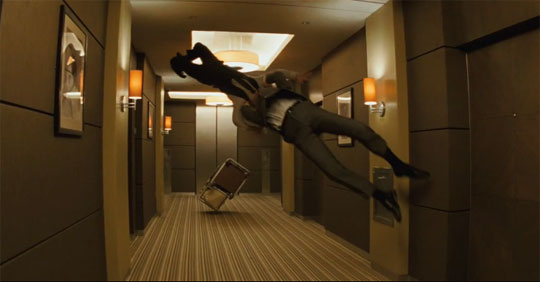
4. Inception. A fun spectacle that was smart and ambitious, Christopher Nolan's overdone dreamworld did things on its terms in a stylized, well-written venture.
5. Black Swan. A vivid, entertaining fable by Darren Aronofsky with a brilliant, crafty performance by the underrated Natalie Portman. It's moral is a little simplistic, but mired in various underlying themes of old vs. new and intentional clichés.
6. White Material. A wonderful parable on racism that's better than any inspirational tale of overcoming adversity in Africa, it's knowledgable and compelling with wonderful direction by Claire Denis.
7. Somewhere. A slow but riveting picture of thick, drowning quality by Sofia Coppola.
8. The Ghost Writer. A wonderful thriller by Roman Polanski.
9. I Am Love. A gorgeously adorned, well-acted film dealing with victorian problems in modern times.
10. All Good Things. A creepy film with wonderful performances by Kirsten Dunst and Ryan Gosling, creates the unsureness about an event like Fincher's ZODIAC.
12. Never Let Me Go. Science-fiction without spectacle puts pressure on three promising young actors.
13. Leaves of Grass. An elegiac portrait within an unlikely source. Edward Norton plays a dual role, and the film grows starkly dark and more and more interesting.
14. The Yellow Handkerchief / Welcome to the Riley's. Both feature great performances by the underrated Kristen Stewart who continues to define herself in her films with special flares.
15. The King's Speech. Still impressive but slightly repetitive and intentional. Despite that it's well adorned, acted, and paced.
16. The Secret in Their Eyes. A great crime thriller spanning thirty years.
17. The American. A slow-paced but intriguing film starring George Clooney as a hit-man which feels authentic.
Another Year
Mike Leigh's ANOTHER YEAR is a film driven by its actors. Leigh always works with his actors extensively before even beginning to film, and here it really shows. This film isn't really about anything, but is driven by mood. Leigh takes us through the seasons, starting with Spring and ending with Winter. In the spring, a happy man and wife named Tom and Gerri Hepple (played by Jim Broadbent and Ruth Sheen) deal with a sad and occasionally drunken friend named Mary (Lesley Manville). Gerri and Mary both work at a clinic. Mary's a lowly secretary, but goes out for drinks with Gerri (who's a councilor) often and barges into their house every once in a while. Mary, however, is not the typical movie-drunk, but actress Lesley Manville portrays her in a nuanced fashion. Broadbent and Sheen are also wonderful in their roles, and as the film progresses through the seasons, tones changing with each one, Mary's downward spiral becomes more and more apparent. It isn't obvious, but buried beneath a façade of cheeriness. The way that Leigh does this is quite admirable. The pace is slow, but it allows us to seep into the world these people inhabit. Bad things happen and good things happen, people die, but people are born. In ANOTHER YEAR, nothing is obvious, but the ideas that we started out with are broken down, and then reconstructed in a different way.
Another Year: ★★★1/2
Thursday, June 9, 2011
Inside Job
This film is dense. It attempts to cover a complicated topic, with words and phrases that are, in themselves, quite difficult to understand. And yet, Charles Ferguson's documentary on the 2008 financial crash and the events / acts / people that led up to that crash is concise, timely, and well constructed. Ferguson's film builds its case from the days of Ronald Reagan and deregulation, shows how mortgages and insurance play their part, and ends, brilliantly, with squirming arguments from squirming men. Although Ferguson's film is quite complex, watching the film feels as if you're undertaking a noble cause as a citizen to understand. This is the power of Ferguson's documentary, and in the very sense of that word, it documents the outrage of the 2008 financial crash. This film is not political but it covers political acts, swaying it towards a final outrage that seems rational and intelligent. INSIDE JOB will be the definitive film on what happened in this time, just how Michael Moore's great FAHRENHEIT 9/11 is the definitive film on what happened during its time. It is a full film, undertaking all of the aspects that are important or at the forefront of a situation.
Inside Job: ★★★★
Inside Job: ★★★★
Subscribe to:
Posts (Atom)