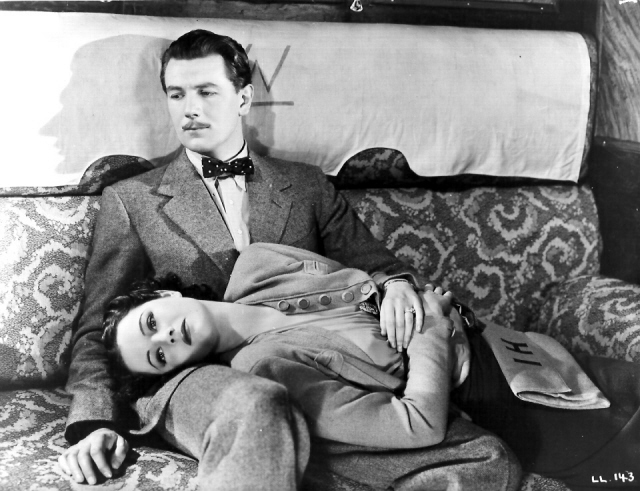
James Whale was a great film director, making most of his masterpieces in the 1930's, when he had a great control over his material. Especially in his film, THE BRIDE OF FRANKENSTEIN, Whale exhibited a great sense of modernity, implanting certain themes that, had they been overt, would have gotten him thrown out of Hollywood. His horror films are great, and, in the case of THE INVISIBLE MAN, pretty effective in whatever way he wants them to be. With THE GREAT GARRICK, though, Whale shows a sense of modernity through comedy. Loosely based off of a real actor known as the Great Garrick in old-era England, the story is about a pretentious stage actor named Garrick, who, with his crony, travels to the theater house in Paris. The Parisians have erroneously heard that Garrick made a speech about them, saying that he plans to "teach them how to act". Deeply offended, the similarly pretentious Paris actors decide to rent out an entire hotel where Garrick is due to stay between his departure from England and his arrival in Paris. Each one of them playing a different part, and completely making up the hotel staff and residents, the actors plan to scare Garrick out of France as mad Frenchman. Little do the French know however, but an old man who loves Garrick's acting, rides on horseback to warn him. What follows is the exploits at the hotel, and Garrick having a one-up on the Paris actors. What is more entertaining though, is that Whale has sided with the man who is pretentious because he is deserving of it, instead of the Paris actors who aren't very good actors, but who act arrogantly anyway.
★★★★ out of Five
Showing posts with label 1930's. Show all posts
Monday, February 27, 2012
Sunday, June 19, 2011
Young Mr. Lincoln
YOUNG MR. LINCOLN has a pretty self-explanatory title, except that it's false. The film pretends to tell the "origin story" of Lincoln, except that the story it tells is fictionalized. John Ford directed the film, placing Henry Fonda in the role of the young Lincoln. We see him with a girl, he leaves, and upon his return, finds her to be dead. He seems heartbroken, and he laments at her grave, asking her what career path he should take. The music swells: a sappy score characteristic of such a propaganda film, which basically furthers Lincoln's standing as an honest, great American. Apart from this being a fake film, the events are slightly compelling. Lincoln decides to be a lawyer, and Fonda plays him as a broken soul, musing intelligently every once in a while like a good, laconic, cowboy figure pervasive in Ford's multitude of other films. Lincoln's convenient chance to prove himself comes at the expense of a death. Two boys seem to be the culprits, and the townspeople are quick to want to hang them. Lincoln, however, attempts to convince the townspeople of good, virtuous American values, and so starts a trial, more sappy music, and more sanctimonious speeches. Fonda is quite good in his role, pulling on Lincoln's earlier, traumatizing experience to play him as a figure who is smart with the conciseness and wit of his words. Ford, directing, also makes YOUNG MR. LINCOLN a lot better than the MGM memo sporting it as a good American film deserves to be. His directing powers at this point are quite great: his mis-en-scene coupled with foreboding scenes that are obviously a reference to Lincoln's later years. This is all unfortunately undone by the film's sappiness, for that just lacquers the film a sense of pre-disposition.
Young Mr. Lincoln: ★★1/2
Tuesday, January 11, 2011
Dracula
I'm afraid (haha) that Dracula is the kind of film I trenchantly admire and few else do. It seems quite long, the beginning especially, the audio blows, and the visuals and killings are done with such phantasmagoria that they can be seen as foolish and not scary. But I believe Dracula to be the most admirable of the old horror films, as well as one of the first films that took an effect upon me. Prior to films like this one, I thought of film as purely a matter of spectacle: Show me something cool and I'll buy the tickets. But Dracula is such a visual experience that that is why it took such an effect upon me. It's so damn atmospheric and creepy that I was totally immersed in the film. I believed in a world. I believed in the culture that existed here, where women are the sex toys to men like Count Dracula. The fear and mounting tension, the catacombic aura, and the stoic face of the great Bela Lugosi affected me in a way that made me love films.
The Lady Vanishes
A while back I gave the great master Alfred Hitchcock a bad review. I disliked Rope, and quite a bit too. Thus, it is only fair now to acknowledge a masterpiece of his. So here is: The Lady Vanishes. Simple enough story too, a beautiful woman named Iris (scintillating Margaret Lockwood) is aboard a train, she befriends an older woman named Miss Froy (Dame May Whitty), and then she falls and hits her head. Iris and Miss Froy are in the train compartment with two foreigners and Iris gets up to go nurse her head. Upon her return, Miss Froy is gone. She searches. Finds nothing. She asks around. Nothing. Everyone seems to have become suddenly foreign, and insist there is no Miss Froy. Iris goes crazy thinking about if Miss Froy ever really existed. (A turn that I looked at while considering realism). Tension builds, truths emerge. This is quintessential in the plethora of Hitchcock work. It clearly shows his mastery over suspense. The film was made in 1938, and it is more suspenseful, witty, and exciting than most of the films I've seen in 2010. The fetishes of the director are also pretty great: his obsession with silly light switches, boxes. The Lady Vanishes is by far not the best film of Alfred Hitchcock, but it is still undeniably good.
The Lady Vanishes: ★★★1/2
Subscribe to:
Posts (Atom)