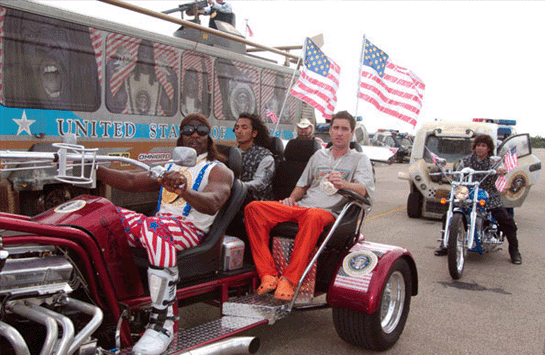
Tony Scott's films are so poorly received it's criminal. Critics and audiences get too hung up on the plausibility of things that happen in his films, or the level of violence or style that Scott ascends to. Such is true from a really entertaining film of his, MAN ON FIRE, which, according to most reviews, descends into an unrealistic and insane level of violence. In DEJA VU though, there's a lot that's open to nitpicking. Hell, the film has time travel in it, and that's one of the easiest things to dissect as utter bullshit. But that's not the point of a Tony Scott film. The essence of his films to allow yourself to be taken on a ride. All of his films are extremely entertaining, but especially the ones existing in the digital age, are extremely specific. They're filled with small moments, small fancies of editing that work dastardly well in the moment, and even, I think, on the bigger scale. Like a mosaic, it's made up of a lot of little perfections, but when you step back, it still makes for a pretty damn good picture. DEJA VU centers on a device that allows Denzel Washington's ATF agent, Doug, to look back into the future four and a half days. Through an odd little suited made up of multiple monitors and a few geeks, Doug falls in love with a victim of a ferry bombing. Attempting to use the technology to discover the bomber, Doug becomes obsessed with the victim, a 30 year old woman burned alive named Claire (Paula Patton). Doug knows that Claire is doomed, but becomes obsessed with the idea that she may not be. The way that Scott creates literally multiple planes of action, one in the past and one in the future, is astounding. There's one great scene where he has to use special goggles to track the bomber in the past, but also has to use one of his eyes to drive in traffic. DEJA VU is a hell of a lot of fun, a masterful action film.
★★★★ out of Five
Showing posts with label 2006. Show all posts
Sunday, March 11, 2012
Wednesday, March 7, 2012
Bug
My only previous exposure to the work of William Friedkin was THE EXORCIST, and I thought that was crap, but, watching BUG, all I could think was that it was the perfect movie for the man who made THE EXORCIST to make. For one thing, THE EXORCIST suffers from a sense of horror that was so in-your-face: loud and ludicrous, that I was bored. BUG, though, takes horror from a bubbling undercurrent higher and higher until it's in your face. For Friedkin's EXORCIST to not really "get" horror, and for BUG to get it, I was overwhelmingly pleased. It plays like a midnight movie, slow going and with a tone that feels like you're hanging out. But with its ease comes annoying phone calls, knocks on the door, visitors, and the original tone is shaken up. Agnes (Ashley Judd) wants to just pass out after a line of coke (don't we all?) but she's haunted by the ghosts of her past. She lost her son years ago, has an abusive husband who's just gotten out of jail even though "he wasn't supposed to get out this time." And then Peter comes into the picture. Michael Shannon, more like, his crazed eyes held in by the muscles surrounding them. Peter's soft spoken, even frail, and Agnes jumps on the opportunity until Peter starts to tell her about his life. He seems crazy...but is he? It's Michael Shannon, so probably yes, but Friedkin handles the situation as if it's ambiguous for most of the film, until the inevitable happens. It's like a good book. You knew the ending was coming the whole time, you just didn't want to believe it, and when it comes...
★★★★ out of Five
★★★★ out of Five
Monday, January 30, 2012
Monster House
MONSTER HOUSE is a timid but entertaining piece of cinema. Heavily influenced by 80's movies where kids figure out what's up in the neighborhood, a trio of timid but entertaining kids investigate the house across the street, which is inhabited by a cranky old man who runs everyone off his lawn. Nearing Halloween, the two boys lose a ball on to the old man, and, frightening the old man, give him a heart attack. They surmise that without the old man, the evil house is growing angry, and, literally possessed, the house begins to devour anyone that comes onto the lawn as if adopting the old man's sensibilities. Seeking help from a legendary video game player, the older sister's punk boyfriend, and even the police, the kids make a trek to uncover the evil of the house. It's an unashamedly ludicrous movie, a little poorly paced, but charming and eventually revealing a couple of creepy, early 20th century imagery.
Monster House: ★★★
Monster House: ★★★
Friday, October 14, 2011
Half Nelson
HALF NELSON is a realistic portrait of drug use. Often, for privileged members of society, or like the well-off history teacher in HALF NELSON, drug use is a pleasant luxury. But once confronted with the means by which those drugs are acquired, it creates a sense of guilt. In HALF NELSON, a dedicated, alternative history teacher named Dan Dunne (Ryan Gosling) teaches his group of underprivileged students about the way history affects their lives, and between classes and after school, smokes crack. Director Ryan Fleck understands drugs though, he gives no specific "reason" for Dan's drug use because most well off people don't have a reason. This is a film about drug's effect on people, and what they mean to specific people. When Dan begins to take a student under his wing named Drey (Shakeera Epps), he sees drugs effect on her life. For him, drugs are an escape and a pleasure, but for Drey, they mark a future of drug running, and are exhibited in the ruined lives of her low-class relatives. Dan's realization of the negative effects on Drey, in contrast to his earlier thinking: that he wasn't hurting anyone by experiencing a solitary pleasure. Furthermore, Fleck strains the worth of Dan, who, on drugs, is still a great history teacher, inspiring his students to whom drugs are a sad future. This is a complex issue, and it is approached with complexity and understanding.
Half Nelson: ★★★★
Half Nelson: ★★★★
Monday, September 5, 2011
Imprint
Takashi Miike is probably the most prolific director of modern times. Back in 2006, Miike was commissioned, along with a number of other horror directors (eg. John Carpenter) to make a film for the MASTERS OF HORROR series. He was guaranteed full creative control with the conditions of a tight budget alone. However, after completing the film, the Showtime network which was supposed to air IMPRINT backed off due to the graphic content of the film. True, with IMPRINT Miike crafts a truly shocking horror film, complete with incest, pedophilia, aborted fetuses, mutation, and rape. Beginning with a dreary boat on murky waters, an American in the Victorian era coasts towards an island with deformed asians. The man, known as Christopher (Billy Drago), watches as the men bury a pregnant woman at sea. They land, and he walks off to a compound filled with whores. The mistress of the house, syphilitic, greats him, her nose deteriorating into fragments. Christopher is told he must stay the night, and picks out a whore from the back, whose hair is blue, her face deformed. He is on a search for a past flame named Komomo, a whore whom he had promised he would save and return to America. The mistress has feigned any knowledge, but the blue haired girl has a story to tell. This story is one that contains torture, and the before-mentioned incest, pedophilia, etc. The rest of the film, consisting of Christopher's prodding and mendings of the whore's story consists of some of the most disgusting and shocking images I have ever seen in a film. To match it is only Lars Von Trier's ANTICHRIST, and yet IMPRINT is more shocking in a universal and effusive way. There is a craft at work here, but also a winking gratuity which is occasionally alienating when it isn't horrifying. IMPRINT also works nicely as an introduction to Miike's work, but one starting here would be so disgusted by the content as to not appreciate the work.
Imprint: ★★1/2
Imprint: ★★1/2
Friday, July 29, 2011
Miami Vice
Digital Night Sky
Images in MIAMI VICE (a 2006 film by Michael Mann) often appear as paintings or elaborate compositions of contrasting images of the same tonality. Consider Mann's dark, navy pasted cops on the top of a bridge against the night sky. Both planes of vision are dark, but Mann's heroes appear starkly against their also-dark-counterpart: the Miami skyline. As a feat of digital photography: MIAMI VICE is a masterpiece. The film, although apparently based on a 1980's tv series that can only inspire visions of corniness, is about two laconic policemen in the modern day. We rarely even hear their names, although viewers of the tv show would not require any introduction, and the cops stand out based on their respective traits. Jamie Foxx (Mann's collaborator on the great COLLATERAL) plays Rico, a stern, cool balance to the recklessness of his partner Sonny (Collin Farrell). Neither men talk very much, and when they do it's in quick, cool phrases rather than full sentences or coherent lay-it-out talk. We gather that both men are on a job to go undercover and reveal how a crime syndicate is discovering undercover cops. The task is dangerous, but the men are both obviously excellent at their work. Sonny gets pulled into the crime crowd, falling for the boss' financial advisor Isabella (Gong Li), and thus complicating his connection with Rico, who is trying to maintain his own marriage. Both men on either planes of relationships fail because of their occupation: inevitability is brought up by Mann with his MIAMI VICE players using primarily subtle actions. The story could be straightforward, but it is instead complicated to allow for nuance to flesh out Sonny and Rico. MIAMI VICE is a pretty great film, different perhaps from high-octane fare like HEAT, but more complicated to evoke the underlying points in COLLATERAL.Miami Vice: ★★★★
Monday, July 4, 2011
I Served the King of England
I SERVED THE KING OF ENGLAND isn't the kind of comedy to throw the jokes in your face, or even make them apparent. Instead, the director Jirí Menzel uses a deadpan style that is occasionally quite subtle. At the start of the film, an old man by the name of Jan Díte is leaving prison. He narrates the rest of the film, remarking as he leaves prison that he was granted amnesty shortening his fifteen years in prison to just fourteen and nine months. He then sighs, and attempts to walk off away from the prison, but his coattail is caught in the prison door. Díte as an old man (played by Oldrich Kaiser) lives a simple life after prison. He reminisces to himself, but remains an enigmatic figure to a pretty young girl living near him. He works tirelessly, and has his eye on her most of the time, but we learn from Díte what this beauty reminds him of. In flashbacks that take up most of the film, a young Jan Díte is seen as a bumbling, innocent-looking waiter who dreams of being a millionaire in 1930's Czechoslovakia. He always wishes to be a part of the elite (the people he serves), and he slowly climbs in stature, going from being a waiter at a coffee shop for posh chess players and drinkers, to being the owner of his very own hotel. Throughout all of director Menzel's comedy in the film, which remains entertaining, an undercurrent of critique is also evident. Like Menzel's understated comedy, this serious vein is also understated, but delightful if (or when) discovered. Díte, for example, will never be accepted into the elite because he will have always have started out lowly. He does not realize this, but we know he one day will from the social standing of the older Díte. Also, Czechoslovakian politics and loyalties are on display. A restaurant won't serve a german before Hitler takes over, but after he does they are bitterly forced to, but resist by attacking defenseless germans and removing their white socks in protest. I SERVED THE KIND OF ENGLAND is a fine, erotic film which is funny, dark, and eventually satisfying.
I Served the King of England: ★★★
Sunday, June 12, 2011
Marie Antoinette
Like Alice following the white rabbit to wonderland, an innocent girl who is slightly intrigued is forced into a new world. At only 14, Marie Antoinette (Kirsten Dunst) was given by Austria to France as an essential gift to intertwine to two nations. She became a princess in a day, leaving her old life behind, and becoming a famous gambler, partier, and eventual Queen of France. The tales we've already heard about Antoinette play up her partying nature without much explanation. It has even been said that her husband, who wouldn't have sex with her, was actually gay. Sofia Coppola's much criticized film addresses the motives and feelings of the 14 year old. Coppola and Dunst collaborate to paint the portrait of a naive teenager who was overjoyed at the life of a princess because she knew few other truths of reality. The horrors that Antoinette is put through seem inevitable within the society. The King, played by Jason Schwartzman, does not seem gay, as they could have made him, but reluctant and unsure of himself. He seems to not even want to play a part in the film, and his awkwardness towards Antoinette is endearing. Perhaps he was gay and didn't know what his feelings meant at the time. He was never outwardly searching for gay partners, but perhaps within the environment of the French monarchy, he didn't know that he should. Dunst is so great in her role as Antoinette that we feel for the character. She lived a sad life, and yet her luxury was at the highest caliber. Sofia Coppola's film is great because she does things we have not seen before in a period piece. Firstly, she uses modern day music to tell the story, which makes more sense than you would think because it evokes a mood. I wonder if in some period pieces which tell of 16th century kings and queens, they don't mistakenly use music from the 17th century. How could people from the 21st tell the difference anyway? Music should evoke a mood, and here it does. Coppola also pays little attention to facts, and tells the story from Antoinette's point of view, and as she is unknowledgeable about France's people, so are we. Coppola also uses her art production wonderfully, but in ways that are specific to the story, and in Antoinette's elaborate adornments, it reminds of a teenaged girl aching for expensive clothes. This is a great film, even though it is thrown by the wayside so often because it is not traditional. Coppola's incessant use of unhappy rich people is perhaps a misplaced moral, but she's damn good at making her case.
Marie Antoinette: ★★★★
Tuesday, May 10, 2011
Wristcutters: A Love Story
This film has a great premise and not enough intelligence to follow through with it. I'm unsure as to whether I'm being too hard on it because I wanted it to be something else, and it was what it was despite that. The general premise is that when you commit suicide you go to a limbo-esque world where everything blows in a quasi-suckish way: things break down, people are unable to smile. The premise is upheld through Zia (Patrick Fugit of ALMOST FAMOUS), who has slit his wrists and has been living in this limbo-world for a few months. He killed himself because he wanted to show his ex-girlfriend how much she hurt him, but instead of ending everything, he started everything: living in misery and apparently setting off a few more suicides. Here lies two problems with the film. 1) It creates this other world without explaining any logistics. Is it so much worse that a slum in Africa? Why do people work when they're dead anyway? How do they sleep? Why hasn't anyone tried to kill themselves again? This is where the film exhibits how it isn't intelligent. It doesn't take advantage of its premise and uses ugly coloring to create an uninteresting parallel world. Problem 2) Everyone has killed themselves to stick it to someone still living, but then they get it stuck to them because they don't get to die. How is that moralistically teaching anyone anything? The strength of WRISTCUTTERS: A LOVE STORY is its characters and how appealing they are. Zia meets a couple of friends on his quasi-road trip, and they make the movie with smart exchanges and dreamy musings about the world. I couldn't get past its primal problems, but WRISTCUTTERS: A LOVE STORY is a decent film that never took any obvious missteps except that it didn't go far enough. Were they afraid? Is this a one-joke, one-line film?
Wristcutters: A Love Story: ★★1/2
Sunday, March 13, 2011
The Bridge
This movie sucks. It's a film that is trying to be edgy, and fails because it's overly simplistic, obvious, and unnecessarily creepy. It's a documentary that has captured a year of suicides at the Golden Gate Bridge. 24 people killed themselves at the bridge in 2004. In the film we see about a dozen of these tales and a dozen descents. The fact that so many people killed themselves at the bridge in a year, and some only a few days apart, is the only interesting part of the entire film. As it begins we watch someone fall and die, and then we hear from family members and observers of the person's last moments, and what led to their decision. A question arises here, why would anyone want to talk about such an event, and then exploit it for a supposedly edgy film? The people who jumped the bridge were obviously mentally ill, and that is quite clear from a barrage of information about the deceased. However, these observations are painfully obvious. The entire film feels like a scene where a reporter asks a Tsunami stricken victim: How do you feel? Well, obviously shitty, good thing we got that out of the way. The Bridge then continues to talk about victims without any doctor involved. Instead we just hear story after story from family members. Not only does this become boring, but cruel as it feels pushy and busybody-esque to be watching the film. The movie has delusions of ominousness, and there are countless shots of the bridge enveloped in creepy fog to strange music. The Bridge has nothing to say. It started out with a possibly interesting idea and then had to decide what to do with that idea. It's schlock.
The Bridge: ★1/2
The Bridge: ★1/2
Idiocracy
Idiocracy is a low-budget film from Mike Judge, who did the great Office Space. It stars Luke Wilson as Joe, who is consistently average in every possible way. Joe and a hooker named Rita (Maya Rudolph) are chosen as the guinea pigs for a military project. They are to be frozen cryogenically and then woken up in the near future. However, everyone who's working on the project either forgets about it or goes to jail for unrelated activity. Joe and Rita are forgotten, and it's not until the mid 3000's that they wake up. They awake to a future of idiots. Man has become so lazy and in-urgent that everyone is really, really, stupid. Trash is piling up, gatorade is used to fuel crops, and Joe is mistaken for a fag because of how he talks. For, in the future "the English language had deteriorated into a hybrid of hillbilly, valleygirl, inner-city slang, and various grunts." Joe sets off to save the world as best an average guy can, and in the 3000's, he is the smartest man in the world. This is often amusing, and with such an original idea, the filmmakers have a lot to pull on for jokes. The film is constantly effective, and has narration that benefits the storyline a great deal. Sometimes it falls into clichéd low-budget movie territory and it is admittedly predictable. However, it's the general idea the film is working with, and how it never betrays that idea, that makes it a worthwhile comedy.
Idiocracy: ★★★
Idiocracy: ★★★
Monday, February 7, 2011
The Fountain
The Fountain is an extremely ambitious film, penned and directed by Darren Aronofsky. It stars Hugh Jackman and Rachel Weisz in what (at first glance) appears to be three interconnected stories that are separated by hundreds of years. However, The Fountain is really just one story, and the other two are manifestations of thought within the book of Weisz's character. Tommy (Jackman) is a neuroscientist. He's married to a dying Izzi (Weisz). She's writing a book while dying entitled: The Fountain about a spanish conquistador. We see some of these scenes with Jackman also playing the conquistador. The conquistador is on the search for the fountain of youth. In some ways, so is Tommy. Tommy is unable to accept death, and although he is distant with Izzi, he is fully involved in his work: which he believes will cure death. There's a lot of similarities between the stories, and then there's the third, which makes little sense. It is just a bald and dramatic Jackman who has seemed to have unlocked immortality. The Fountain is an endlessly complicated film. It reminded me of 2001 in the way it is open to interpretation. Despite the emotion that Jackman and Aronofsky have brought to the film, it is hard to describe its flaws and anything but missteps. For that is what it does. It uses light at the wrong times, it goes from trenchantly sad to a spectacle in an instant, it is too brisk and fails to take its time. Mostly, it disappoints, for greatness is perhaps within it. It's finally a good film because of how interesting it is, but it could have been much more.
The Fountain: ✰✰✰
The Fountain: ✰✰✰
Monday, January 17, 2011
What the Bleep Do We Know!?--Down the Rabbit Hole
And now for one of the stupidest, and yet most pretentious movies I have ever seen. WTBDWK with it's ridiculously puerile title and ongoing silliness (including delusions of originality with amateurish cuts and animations) tries to convince us that the world is a very complicated and groovy place. They have a chiropractor who talks about the molecular structure of water being altered by though waves (oh yeah, because they teach you that at 'fake back doctor school'), and a bunch of actual physicists who admit that they make up shit to understand what's impossible to understand. Most of the people interviewed are bullshit physicists. For example, this line came up "I'm not actually a physicist yet, but I'm trying! I've written two books about the subject already". Oh how this movie BLOWS. We have a quasi-interesting story about a deaf woman who is pissed off about something they don't even explain and have her go loopy over the wonder of the world. She apparently misses her job by thinking about this bullshit, and then ends up making it to work on time even though she just got chewed out for being late. The interviews with the scientists and intermittently placed around the film. I admit wholeheartedly that conversations about time and life and why we're here fuel my existence. Which is why it does nothing but piss me off that such an amateurish, pretentious ("It's the epitome of human arrogance to put god in our image, god doesn't exist. Actually, I'm god, I control everything and morality doesn't exist"-overweight sleep therapist talking about quantum physics...), and shit film would take such interesting ideas and actually warp them and dumb them down.
What the Bleep Do We Know!?--Down the Rabbit Hole: ★
Monday, November 29, 2010
Harry Potter and the Order of the Phoenix
I would be lying if I didn't honestly say that I did not like this film. After rewatching and catching bits of wit within the early Potter movies, this one was a huge disappointment. It doesn't mean anything. It's nothing. The book was dark and disturbing, I'm not sure if I like it very much. It is so unrelenting in its cruelty that it angered me, and the payoffs where the kids strike back at the Voldemort denying Ministry puppets were not good enough. There is no magic in this movie. Or there is very little. There is no comedy. I also admit I couldn't help but enjoy the characters and the wonderful actors who by this point are so natural in their parts some are star making (Emma Watson). But this is a devious movie. It has one especially sick scene where the entire group of students who have been secretly practicing to protect themselves are sitting before a fat old woman carving into their hands. And it's not at first noticeable, but look closer and be sickened. However, there are some very good bits of the movie, despite its many problems (which is inevitable in a film series as long as this). Some of the scenes at the ministry are very well done, as are some of the early scenes (the scene with Dudley is masterful). I don't think that this movie should be forgiven for not being very good. I love Harry Potter, and this isn't bad, but after so many good films, it's such a disappointment to see a mediocre one like this.
Harry Potter and the Order of the Phoenix: ★★
Sunday, November 14, 2010
Little Miss Sunshine
Little Miss Sunshine is not by any stretch an intelligent film. However, you can tell that it's writer was. For the film allows the misadventures of the family to display the level of retardation of many different peoples. The film is about a family that is traveling to a child beauty pageant in their shitty hippie bus. The bus can only start by rolling down a hill and reaching a certain speed (this results in one of the best parts of the movie where Olive (the girl for the pageant) is left at a gas station). The film is pretty good, although it has the tendency to be too quiet or too annoying. The deadpan Carrel as the suicidal gay uncle is very well played, and Alan Arkin as the inappropriate grandfather is also excellent. The rest of the family (the mother and father) are obnoxious. The way that the film gains speed though, is very pleasant to watch. The characters are at such a high level of bullshit within their own lives and in dealings with others, that its funny to watch them try to live in the real world. Shit keeps piling up and this family is placing all their hope in a beauty pageant where 10 year olds are dolled up as women. This is funny, so's the movie.
Little Miss Sunshine: ★★★1/2
Subscribe to:
Posts (Atom)