Belá Tarr's WERCKMEISTER HARMONIES is a film that requires a complete surrender. Surrender, and you enter the film's world, with long, 10 minute long takes and an effusive sense of inevitable destruction. The plot is simple: a couple of exhibits that would belong in a circus enter town. One of them is a giant whale. Another is a man known as "The Prince", who never actually emerges, but unsettles the townspeople regardless. One young man, named János, is unaware, or unable to accept that destruction is coming. He walks among rude townspeople and rude neighbors spewing flowery ideas, and visiting the giant whale. He sees the whale as a wonder of the world, a testament to that which God can create. But Tarr's methods are brilliant. Each shot (and there are only thirty-nine of them) is masterfully rendered, the black and white, the actors, and the direction all add to sense that are specific. But Tarr's destruction is one that is not jabbing, but one that is sad and inevitable.
★★★★ out of Five
Showing posts with label High Level of Difficulty. Show all posts
Sunday, April 1, 2012
Tuesday, January 31, 2012
Monday, October 31, 2011
Henry: Portrait of a Serial Killer
Despite much of the talk that has been made about HENRY: PORTRAIT OF A SERIAL KILLER, it is no horror film in the conventional sense of that terminology. It's too slow, too biliously building to be that kind of abrupt horror. Rather, HENRY fits into a disturbing group of cinematic quasi-breakthrough. Released Unrated in the 80's in order to avoid an NC-17 rating, HENRY tells the sickening tale of a tall, stoic drifter named Henry (Michael Rooker). He lives in an apartment with a drug dealer just out of jail named Otis. Henry kills people, he's a serial killer, but no enigmatic, hammy type like Hannibal Lecter. Instead, Henry is cold and gross. We see his mangled victims, each killed in different ways to keep the cops off his trail, and the camera pans in on their empty eyes, their screams acting as background music. One day, Otis' sister Becky comes into town. She begins to live with Henry and Otis, and takes a great liking to Henry. She's a damaged person though in the greatest sense of that elusive phrase. Molested as a child, Otis has the same tendencies as their deranged father, and Becky's in danger. Henry and Otis start killing people together, and Becky stands on the sidelines in some sick admiration and some ignorance. What is ultimately devastating about HENRY though is the coldness of its subject, and the relentless sickening scenes after sickening scenes. There's not even a style to the kills, but an ugly abruptness followed by quasi-methodical ritual. As what it purports itself to be, a 'Portrait of a Serial Killer' HENRY is a good film, but just that. For reasons I cannot pin down, its detachment, and the general pathetic-ness makes the film appear as disaster porn. Still, however, worth seeing.
Henry: Portrait of a Serial Killer: ★★★
Monday, September 5, 2011
Imprint
Takashi Miike is probably the most prolific director of modern times. Back in 2006, Miike was commissioned, along with a number of other horror directors (eg. John Carpenter) to make a film for the MASTERS OF HORROR series. He was guaranteed full creative control with the conditions of a tight budget alone. However, after completing the film, the Showtime network which was supposed to air IMPRINT backed off due to the graphic content of the film. True, with IMPRINT Miike crafts a truly shocking horror film, complete with incest, pedophilia, aborted fetuses, mutation, and rape. Beginning with a dreary boat on murky waters, an American in the Victorian era coasts towards an island with deformed asians. The man, known as Christopher (Billy Drago), watches as the men bury a pregnant woman at sea. They land, and he walks off to a compound filled with whores. The mistress of the house, syphilitic, greats him, her nose deteriorating into fragments. Christopher is told he must stay the night, and picks out a whore from the back, whose hair is blue, her face deformed. He is on a search for a past flame named Komomo, a whore whom he had promised he would save and return to America. The mistress has feigned any knowledge, but the blue haired girl has a story to tell. This story is one that contains torture, and the before-mentioned incest, pedophilia, etc. The rest of the film, consisting of Christopher's prodding and mendings of the whore's story consists of some of the most disgusting and shocking images I have ever seen in a film. To match it is only Lars Von Trier's ANTICHRIST, and yet IMPRINT is more shocking in a universal and effusive way. There is a craft at work here, but also a winking gratuity which is occasionally alienating when it isn't horrifying. IMPRINT also works nicely as an introduction to Miike's work, but one starting here would be so disgusted by the content as to not appreciate the work.
Imprint: ★★1/2
Imprint: ★★1/2
Monday, July 11, 2011
The Intruder (L'intrus)
Reckless, Unfocussed Thoughts on an Enigmatic Film
Claire Denis' THE INTRUDER is a French film of pure poetry. Reminiscent of T.S. Eliot, her images and storyline seems at first impenetrable. In THE INTRUDER, Denis continues her line of work centered around racism, and race in general. Her main character, Louis Tebor, is a man who lives in (or near) the woods with his two dogs. One night in the darkness he hears stirring outside, leaves his bed, and kills an intruder. He hides the body, he dreams of mass torture / violence, and we can see that he has just had a heart transplant or open heart surgery. He is searching for his son, who is an islander boy he abandoned, he wants to leave all of his money to this boy, he releases his dogs into the wild, he cruelly looks about the screen. This is what happens in THE INTRUDER, and the sequence of events and connections were not always clear. This was only my first time viewing Denis' film, but I could tell that multiple viewings would clarify or enhance the experience. Accompanying THE INTRUDER is a wonderfully dark and modern score: one of the best I've heard to accompany a modern film. Despite its complications, it is not difficult to understand the main narrative at work: 1. Louis Tebor must accept his heart, but his son cannot accept him. 2. This is a visual film which is supposed to haunt its viewer. I concede that I did not fully understand THE INTRUDER, but I was aware of its greatness that hid beneath layered storytelling and images. I will, without a doubt, return to this film, but for now it was merely good.The Intruder (L'intrus): ★★★
Wednesday, June 29, 2011
Crash
Like many other films, CRASH is so upsetting that second viewings are hard to come by. Its counterparts of this syndrome would be Darren Aronofsky's REQUIEM FOR A DREAM, or Lars Von Trier's ANTICHRIST. These films each have something within them that is either so revealing of raw humanness that to re-see such harrowing things would file under masochism. But, then again, many American films exhibit how masochistic the audience is. Any horror film, where an audience becomes frightened, is an act of semi-masochism. Tension is too. But CRASH is a special case because it varies from the expected horrors within a film. CRASH is, at its heart, a fantasy, but one that parades itself as existing within the real world. It tells of a man (James Spader) who crashes his car head-on into an oncoming vehicle. The man in the car (who is presumed to have not been wearing a seatbelt) flies out and dies immediately, but the woman (Holly Hunter) survives, and as she escapes the car, her breast pops out which Spader's character looks at in surprised pleasure. Later, the two are at the hospital. Scars and scabs adorn their bodies, and Spader's character still gets turned on by his predicament, screwing his wife, and later the woman whose husband died in the crash. He later discovers more people who share his fetish: car crashes, which turn him on sexually. He gets involved with all of these people because of the love of cars, and that the story sometimes doesn't make sense only supports the idea of sexual compulsion. Many who hate this film, I fear, would take it's ideas of cars turn people on seriously. But this is merely a substitute for any number of odd turn on's and its creepiness only serves to support how creepy some turn on's are, and what they lead to. CRASH is a brilliant film, although it is occasionally upsetting. It's a porno, but instead of naughty nurses entering as foreplay, the car crashes are the foreplay.
Crash: ★★★★
Crash: ★★★★
Saturday, June 25, 2011
The Tree of Life
Much has been said of this film, and most of things sound like they came from inattentive people. To say that this film is complicated is true, but to say that it is hard to understand is not only a different statement from "it's complicated", but also, untrue. THE TREE OF LIFE is quite straightforward, even though it's done in a fragmented way. But for a film that run 2hrs 12min, at the end of it, if I didn't know what I'd watched, I'd have been pretty disappointed in myself. Furthermore, the film is quite the spectacle, the photography in the film is outstanding, making THE TREE OF LIFE one of the best looking films ever. I fear that this strength, however, and the complex nature of the film, has prompted many to stamp the film with a clean bill of health, an A+ in filmmaking, without considering the many flaws of the film. Just because so many parts of THE TREE OF LIFE are brilliant, that does not make the film as a whole brilliant.
The film tells the supposedly semi-autobiographical story of its director, Terrence Malick. In his hometown of Waco, TX, a family grows up, and tension is astir. A father, Mr. O'Brien (Brad Pitt) treats his children sternly in the tradition of demanding nature, and a mother, Mrs. O'Brien (Jessica Chastain) treats her children with grace, attempting to protect them from penetrating forces. The film begins with the O'Brien's receiving news of their son's death. They lament, and so does their son (Sean Penn), who thinks back on his childhood in personal, fragmented memories that are dreamy and etherial.
The film then goes off on a tangent, which attempts to place the trivialities of the O'Brien family against the force of the universe. This cosmic tale begins with the big bang, trillions of galaxies, and finally earth, boiling magma, dinosaurs, and ends with the O'Brien's. Mrs. O'Brien has countless voiceovers in a whispered, pathetic voice that is at times laughable, but when contrasted with the cosmos, seems endearing. The Book of Job is referenced here (not as well as in the great Coen brother film, A SERIOUS MAN), but to the effect that the lives of the O'Brien's are trivial.
Malick then takes us back to the O'Brien children when they were children, showing them grow from infants to young boys, fighting their father, fighting each other, and becoming concerned with simple objects that are obviously personal and reminiscent to Malick. This is also a well photographed sequence, but not as strong as the others in its obvious personal nature: which feels foreign to many who haven't experienced things the way Malick has.
Finally, the living son as an adult is still lamenting, and the earth is destroyed when it is enveloped by the expanding sun. In a scene so obviously akin to 2001's last sequence, the son discovers his parents, and his brothers on a beach: the world ends, but some solace has been found.
Terrence Malick's film is an obvious work of genius when it comes to the photography, but in terms of sheer storytelling, it is a great failure. This is still not a bad film, for this is a film of ideas and of memory: not of plot or story. Images and sounds have the ability to entrance, and by the end of the film, it is not Malick's tributes that matter, but the bits of humanity that, cherrypicked, show a man working to encompass mankind. His filmmaking is flawed, occasionally bilious as he is frantic and restless, but his ideas are sound.
The Tree of Life: ★★★1/2
The film tells the supposedly semi-autobiographical story of its director, Terrence Malick. In his hometown of Waco, TX, a family grows up, and tension is astir. A father, Mr. O'Brien (Brad Pitt) treats his children sternly in the tradition of demanding nature, and a mother, Mrs. O'Brien (Jessica Chastain) treats her children with grace, attempting to protect them from penetrating forces. The film begins with the O'Brien's receiving news of their son's death. They lament, and so does their son (Sean Penn), who thinks back on his childhood in personal, fragmented memories that are dreamy and etherial.
The film then goes off on a tangent, which attempts to place the trivialities of the O'Brien family against the force of the universe. This cosmic tale begins with the big bang, trillions of galaxies, and finally earth, boiling magma, dinosaurs, and ends with the O'Brien's. Mrs. O'Brien has countless voiceovers in a whispered, pathetic voice that is at times laughable, but when contrasted with the cosmos, seems endearing. The Book of Job is referenced here (not as well as in the great Coen brother film, A SERIOUS MAN), but to the effect that the lives of the O'Brien's are trivial.
Malick then takes us back to the O'Brien children when they were children, showing them grow from infants to young boys, fighting their father, fighting each other, and becoming concerned with simple objects that are obviously personal and reminiscent to Malick. This is also a well photographed sequence, but not as strong as the others in its obvious personal nature: which feels foreign to many who haven't experienced things the way Malick has.
Finally, the living son as an adult is still lamenting, and the earth is destroyed when it is enveloped by the expanding sun. In a scene so obviously akin to 2001's last sequence, the son discovers his parents, and his brothers on a beach: the world ends, but some solace has been found.
Terrence Malick's film is an obvious work of genius when it comes to the photography, but in terms of sheer storytelling, it is a great failure. This is still not a bad film, for this is a film of ideas and of memory: not of plot or story. Images and sounds have the ability to entrance, and by the end of the film, it is not Malick's tributes that matter, but the bits of humanity that, cherrypicked, show a man working to encompass mankind. His filmmaking is flawed, occasionally bilious as he is frantic and restless, but his ideas are sound.
The Tree of Life: ★★★1/2
Monday, June 20, 2011
In the City of Sylvia
IN THE CITY OF SYLVIA is a Spanish film by José Luis Guerín. It's slow going and extremely languid, telling vaguely of a man visiting a French city after not having been there for six years. He sits at a local coffeeshop with a terrible waitress, sketches, and searches faces for a woman named Sylvia. One of his sketches is of this mystery woman. It's entitled Elle (Her) and then retitled as Elles (Them), to suggest that his search is probably in vain, and perhaps even that Sylvia represents an intangible idea or presence, rather than a specific person. During this scan of coffeeshop women, he discovers a woman in red, perks up, and follows her around town. This is pretty much the extent of the plot, but Guerín's film is visually inventive, knowledgeable about cities, and more importantly, knowledgable about the average bored individual man and his milieu. During the coffeeshop scene where the man sketches and re-sketches the various women, Guerín's camera only unveils little bits of the scene: first revealing a man and a woman sitting next to each other looking anxious, and then returning to that man five minutes later revealing that the man is sitting at an opposite table from the woman earlier, and that he is with his wife at his own table. Guerín's inventiveness consists of various glances and suggestions about the sketcher's feelings. The women he sketches are all vastly different from one another, but all quite beautiful. In the essential chase scene that comes later, when the drawer follows the woman in red, we see an entire town slowly and in fragments as the woman circles around the square through shops, alleys, and street crossings. Even in the picture added in above, a simple scene of a woman waiting for the train is accentuated by the picture of a model who seems to be glancing in the direction of the woman waiting. The woman who waits is not as beautiful, and she seems tired and old as she waits. Later in this same scene, Guerín cuts to a breathtaking woman wearing a shawl and sunglasses. And even later, he cuts back to the same woman, who takes off her sunglasses and reveals ghastly burns. IN THE CITY OF SYLVIA is a gorgeous rendition of city, sound, and nervous glances. These glances lead to every event in the film: the chase, the sketches, the woman with burns, the woman waiting. It's suggestive, and yet illusory. It would be presumptive to say that I understood everything in Guerín's film, but it dared me to look, and to try to understand. That is cinema at its greatest, its most human.
In the City of Sylvia: ★★★★
Friday, June 10, 2011
Meek's Cutoff
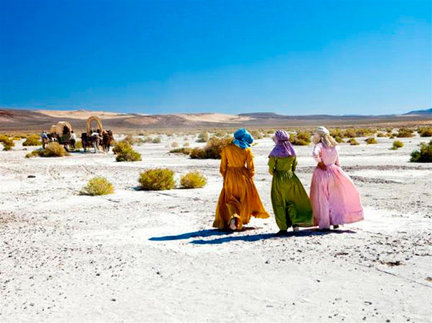
MEEK'S CUTOFF is a daring film. It is about a small group of travelers traversing the Oregon trail. They meet a man named Meek (Bruce Greenwood) who knows a sort of shortcut, and takes them on it. It turns out, however, that Meek has no idea what he's talking about, although he talks a lot, and the group finds themselves lost. However, the events that I have just described are not explained in the film, and they have already happened by the time the film starts. For quite a while nobody talks in the film, and nobody makes it clear that they are lost. Most of what I explained above I inferred from what the film presented me with. Not only is such a film demanding of its audience, but it is endearingly trusting of an audience. The film by Kelly Reichardt is very well directed. It would have to be, for there is not much of a story to it, and I can easily see many being bored by it. I was not; instead I discovered a buried tension, and stirring hopelessness that slowly emerged from the landscape. As the group becomes lost, the actors involved convey the realism that Reichardt is attempting to evoke wonderfully. Reichardt has created, with MEEK'S CUTOFF a film that is extremely authentic to what being on the Oregon trail in the 1840's must have been like, and the actors, with their dirty faces often shrouded in shadow, slowly go mad at their predicament. The final scene of MEEK'S CUTOFF is so powerful that it elevates the film from where it was already going. It makes us realize something anew. This film is one that I'm sure will alienate many. It is slowgoing and the ending will dissatisfy many who were willing to go along with it. But if you can stick with it, you'll discover a wonderful gem.
Meek's Cutoff: ★★★1/2
Sunday, May 8, 2011
Shotgun Stories
SHOTGUN STORIES begins with cinematic music in an un-cinematic setting. Sure, there are striking images throughout, and occasional lingering upon images to provide a sense of place, but for the most part, SHOTGUN STORIES is not a cinematic film. I should say, it does not call to attention that it is a portion of the cinema. Only its music does this, coming in between scenes, and then fading away to let the action happen. The film, made on a shoestring budget, concerns two groups of feuding sons of the same father. This father was a drunk, and married a "hateful woman." With her he had three sons whom he named: Son, Kid, and Boy. Then, he walked out on them. Apparently though, the father cleaned up his act, remarried and had a second group of sons who only share the last name Hayes with the neglected sons. Son Hayes (Michael Shannon) is the rock of his side of the family, looking after Kid and Boy, both of whom don't do much except drink beer on porches, sit by the river, and watch life go by. What's interesting here is that although the second group of sons had a steady-going father, they are no less trashy than the first set. When the father dies, and Son talks hatefully of him at the funeral, the hatred that has been welling up in the neglected sons' heads comes out, and the second set of sons fight back for their fathers memory. From that point onward, there is a feud. It's ugly and realistic in the way it unfolds. What makes SHOTGUN STORIES so great though, is not its striking imagery, storyline, budget woes, or music, but the way the actors work. Everyone is so matter-of-fact and in-urgent despite the presence of urgency that we see the way a group of people act, and why.
Shotgun Stories: ★★★1/2
Thursday, April 21, 2011
Undertow
UNDERTOW is the third film from David Gordon Green. His films are recognizable and textile, and the added bits of implanted importance in UNDERTOW make it all the better. The best way I can describe the film is as a mix of the plot of NIGHT OF THE HUNTER, a sultry southern evening, and cautionary tales of family. The film is concerned with the lives of two strange and isolated children living under a demanding father (Dermot Mulroney). One day, their lives are changed when their absent uncle shows up, tells a tale of mexican gold, and begins to chase the frightened children. There really isn't much to UNDERTOW except emotion and appearance. It could be called a slow film, but its nice to revel in moments rather than skip them by. Green creates a poetic and engrossing film that never feels pretentious, and in its awkwardness it is, perhaps, grand. The way that Green creates a romance at the beginning and adds all the tension to be mustered within it is brilliant, as later on we see how a seemingly simple act can doom a character later on. There's a sense of constant renewal and returning in UNDERTOW, as if the boys have returned to a truth, or where they were going to end up inevitably. UNDERTOW is almost as good as Green's great first film, GEORGE WASHINGTON, and has many of the same dark themes.
Sunday, April 17, 2011
White Material
Claire Denis' WHITE MATERIAL is the most strikingly original film in a long time. It's style feels Scorsese-esque in its necessity to observe violence, but the composure is fully Denises. The film stars Isabelle Huppert as a once-wealthy white woman living in an unnamed African country. We start the film at the end, thus knowing what horrors will befall her, and then we go back to the beginning, where an always frazzled Huppert tends to her coffee crops. She has a son who deals with having no identity (he is a child of Africa, but white, although he feels connected to the rebellion). Like in the stories we hear today of Africa, there is a bloody rebellion going on, and the leader of the rebellion: The Boxer, hides out in Huppert's barn-like fortitudes. As Huppert is urged to leave by pretty much everyone, she continues to fight for her land, although it is painfully clear to the audience that the woman is looking after fucking coffee. We learn that she won't even make a profit out of the coffee, its contaminated by dead animals, she won't be able to transport it, and yet she still looks after it. This is an insanity that is so integral to Huppert's character. Denis shrouds Huppert's eyes in her messy hair to exhibit her blindness, and attires her film as fetishistically as Hitchcock. WHITE MATERIAL is a masterpiece, quiet and then loud like fingernails on a chalkboard waking us up. The way that Denis follows her characters in never condescending but observatory, she's a great director, and this is a great film.
White Material: ★★★★
Friday, March 18, 2011
Around a Small Mountain
Around a Small Mountain is a dry and contemplative film by the 82 year-old Jacques Rivette, who was one of the prominent figures of the French New Wave movement over forty years ago. With Around a Small Mountain things happen quite slowly and rise out of small ideas or musings. It begins when Kate (Jane Birkin) has her car break down. A man comes up to help her and then leaves without speaking a word. Later, they meet in the city and Kate reveals to the man, whose name is Vittorio (Sergio Castellitto), that she is a circus performer. He is intrigued, and because he has nothing else to do, he goes to the circus. This is not the extravagant type of circus with elephants and tigers that inhabits the minds of most people whenever they think of circuses, but one that is referred to as "classic" and is truthfully failing. When Vittorio laughs loudly at an act by the clowns, they approach him afterwards to ask why. (They must have not seen such happiness towards their work in a long time). Vittorio becomes integral with the circus, and he almost becomes a sort of outside force that threatens to change them. This is perhaps for the better, and as the motives of Kate become clear: why she is in the circus, her past, etc. a sort of tenderness grows between the once silent Vittorio and Kate. This is all done beautifully, and the dialogue feels real. It reminded me of Steven Soderbergh's film Bubble in its insistence to show realism. At times this realism grows dull, and the dry nature of some of the characters evokes shrugs. But the strength of Vittorio's entrance into the world of the circus and the smart direction by Rivette creates a worthwhile film.
Around a Small Mountain: ★★★
Friday, February 25, 2011
The Sound of Fury/Try and Get Me!
The Sound of Fury is a fine, 1950 film noir. It has all of the marking of noir, and although it is devoid of striking camera movements, it is at times inventive with them while maintaining the main theme of film noir. This is, of course, the average man who is sucked into evil by unfortunate circumstances. And so we are left to consider Howard Tyler (Frank Lovejoy). He is unemployed but dearly loves his family and their approval. Seeing no alternative, Howard turns to crime for the allure of big bucks is to much to pass up. He gets mixed up with Jerry Slocum (Lloyd Bridges, father of Jeff Bridges). Slocum and Howard end up robbing a few minor stores, but pulling in a decent heap. The media makes a big deal out of all of this, instigated mostly by a journalist played by Richard Carlson. Eventually, things begin to go downhill for Howard, as the evil of his actions begin to arise. Now, the beginning of The Sound of Fury is quite good. The family portrait and the descent into shadiness is well done, and the opening title is a wonder. The film is especially good at conveying the normality of man, and how it can be twisted around to form spectral figures in our heads that we can demonize. This is not a great film, however, because the end finally feels preachy and self-righteous. Not to minimize some truly great scenes that come before this however, The Sound of Fury is a good film.
The Sound of Fury/Try and Get Me!: ★★★
Saturday, February 19, 2011
Knife in the Water
Knife in the Water is the first film by Roman Polanski. Polanski is, today, one of the greatest living directors--his talents are focused and defined. However, it was apparent in Knife in the Water that Polanski was toying and fiddling with many ideas that would eventually become honed-in-upon trademarks. For, in his debut, Polanski almost fervently employs his themes of claustrophobia, guilt, and tension. Hell, the entire film (or 90% of it) takes place on a boat. The story isn't much too. A couple pick up a young, unnamed hitchhiker and end up persuading him to go sailing with them. As the film progresses, there becomes a dualist nature of young and old with the married man and the hitchhiker boy. Eventually, violence breaks out and sex enters the playing field. And I enjoyed the scenes where the tension broke through, but the earlier scenes which made up about half the film were just too boring. The characters seem fine with everything, and I think it was Polanski's need to have something strange occur. There was no real tension in the earlier scenes, and that is apparent because of the dialogue (which is infantile in its use and depth). I admire much of the camerawork and toyed around with themes, but the film ultimately fails to simmer and then abruptly comes to a boil.
Knife in the Water: ★★1/2
Saturday, February 5, 2011
Biutiful
Biutiful is a film directed by Alejandro Gonzalez Iñárritu. He's a well established directors whose made non-linear films like: 21 Grams, Amores Perros, and the acclaimed Babel. All of his films deal with sin, guilt, and (for lack of a better term) shit happening. Biutiful is no exception to the obsession with these themes, and it's a difficult and contemplative film. I do not like it or have much affection for it, but it is a good film. Actually, the film is so effective that it is impossible for me to have affection for it. It is such a devastating and heavy film that it is at times unbearable. It follows a low level criminal named Uxbal (Javier Bardem) whose wife is nuts, kids are needy, and work is falling apart. To make things worse, he's dying of cancer. We see a man who wants to do good despite the bad things he's done. He's a good father, a good man, but he's bogged down by the past and the looming future. In one scene where he tries to help a group of chinese workers, he fucks up because he wants to save some money, and the worst happens. We see Uxbal go from bad to worse, and as all these terrible things build up, he reaches a breaking point. However, this breaking point won't even matter, for soon, he will be dead. Biutiful is at times a gorgeous and heartbreaking film, accentuated by the great performance of Javier Bardem, who evokes sadness and desolation better than most actors using his face alone. The film is admittedly too long, and at times it drags, but in the end, it appears as if there is some hope in Biutiful. It shatters the world and then suggests all might not be lost in a great scene at the very beginning, and at the very end. Biutiful is by no means a great film for Iñárritu to make, and I fear he lets his personal involvement with the movie lessen some of its translation to an audience from shots exclusive to him. That being said, it's a good film.
Biutiful: ✰✰✰
Biutiful: ✰✰✰
Tuesday, January 18, 2011
Disgrace
Disgrace is a film that starts so intensely I could hardly believe it. It's at once clear that Disgrace is no murder-case or action type film, not even in the indie version of that. Rather, it begins with sex. This sex is uncomfortable, however, for we have the manipulative and lustful John Malkovich seducing one of his students. They have sex. She tells. Malkovich is outcast immediately. He makes no secret of his affairs, he is at a level above the people he deals with. He believes that he is at such a level of intelligence that they don't even deserve his explanation. Malkovich evokes the image of a devious and sick man. Then the movie shifts gears, and Malkovich is now living in Australia with his lesbian daughter. One day, he is attacked by aborigines. They pour him with gasoline and then light him on fire. He nearly dies, and in his distress, they rape his daughter. Now Malkovich is humbled by absolute evil. He tries to understand, to fight back. But his daughter strangely wants to forget it all. He cannot understand. He is incapable. Disgrace is a film so concerned with this character that it seeps with the power of Malkovich. His character is immediately convincing and we move from listening to a story to analyzing in from within. Disgrace is a complicated and intriguing film. It's about racism and moving on, one of the best films of 2009.
Disgrace: ★★★★
Disgrace: ★★★★
Monday, January 17, 2011
Antichrist
Okay, what to say about Antichrist, a film about pure evil. Two things to start off, these are the essential things you have to know. 1) I don't think anyone in the world should ever see Antichrist, it is so grotesque and disgusting that I threw up when I first saw it. It is so disgusting the parental guide description on IMDb will make people sick. 2) It's actually not a bad movie. Despite what occurs in Antichrist, it happens for a reason. We start with a beautifully filmed and horrific scene where a child falls from a window. The snow that falls against the night sky, the silvery images are very, very well done. Hell, the whole film is well done! The first hour is the creepiest and best horror movie you will ever watch. The second hour is not even a part of absurdity, but absolute, intentional disgust. After the child has died, we have to endure grief with the parents. They go to a cabin in the woods to mend their wounds, and all hell breaks loose. The second hour is quite problematic, it's so shocking and frankly gross that I didn't enjoy what I was seeing. The last scene is, again, beautiful. We understand what occurs in the film, we can understand the insanity, but it makes us sick. I think that Antichrist is the scariest film ever made, an achievement in horror. I hate parts of it, but I think I'm supposed to. I'm not sure if Antichrist is a great film, or even if I like it.
Antichrist: ★★★1/2
Antichrist: ★★★1/2
Subscribe to:
Posts (Atom)