Showing posts with label 1970's. Show all posts

Thursday, June 7, 2012

Deep Red


Dario Argento’s DEEP RED establishes horror through truths that are slowly uncovered by a normal man. This man, a pianist and music teacher named Marcus Daly, becomes entrenched in the horror. His neighbor, a psychic who has enough credence to speak at public events with scientists, is brutally stabbed to death. Hearing her screams from the street, Marcus rushes upstairs to save her, but is only able to pry her body from the glass of the window. He sees a painting though, which later disappears, and is immediately drawn to the case, acting detective even though he really just knows how to play the piano. But Marcus is thrown deeply into a horrific world, his perceptions of everything changing, from an old house he would have considered quaint containing dead bodies and weird pictures, and his friend Carlo being unmasked as gay, and a little crazy. Argento’s storytelling is perfect though, with little mysteries being unveiled as an ultra-regular man tries to make sense of it all: unfairness following his every move, artily rendered under the deep red of flowing blood or a boiled face.

★★★★/5

Sunday, April 29, 2012

Rabid

As David Cronenberg's second distributed feature, RABID is a wonderfully textured and stylized testament of the seventies: one of the greatest manifestations of the decade by transposing all of the newly discovered realism into grungy settings. A free but actually useless protagonist on his motorcycle crashes when a family car gets in the way, sending his girlfriend into a coma. Futurist music glides over the steamed up streets and grungy malls of RABID and the girlfriend named Rose (porno actress Marilyn Chambers) gets an experimental skin graph at a doctor's clinic. She remains in a coma, but awakens sooner than the doctor's anticipated or know. Turns out the experimental procedure has rendered Rose a monster, a vampiric thirst for blood contrasted against her knowledge that what she does is wrong as she creates an epidemic of rabid, infectious creatures across town. Cronenberg keeps the monsters subdued though, looking more like fevered madmen than the easily describable zombies. But Cronenberg's aesthetic works wonderfully here, and the supposed hero of the film actually shows himself to be a weak loser, unable to do much and failing at every opprotunity. Instead, Rose is the complicated one who doesn't want to believe that she's created this disaster, and Chambers' rendition is perfectly directed, her curved lips making the perfect blood-thirsty femme fatale.

★★★ out of Five

Fritz the Cat

Coming from the underground cartoonist, Robert Crumb, FRITZ THE CAT was the first animated film to be X-rated, and was notably not endorsed by Crumb himself. The film is an ugly manifestation of half-baked ideas, putting Fritz as a hip cat of the 70's who's sexually free but intellectually bland, scowling at everything without having any ideas of his own, and thus immature and weak. The film isn't really about anything except the adventures of Fritz the Cat, as he flees from some pig cops whose pants often fall off to reveal their penises, and a few black crows who offer a couple of funny but racist lines. This is not an terrible movie because of its odd and fetishistic sexual tendencies as Robert Crumb suggested, but because all of its anti-political or supposedly edgy stances are rooted in a sublime ignorance of the contrary argument, subversively heckling but not being very interesting itself.

★ out of Five

Thursday, April 12, 2012

The Brood

The normalcy with which THE BROOD begins is its greatest strength. Opening to a couple of men sitting on a stage, hashing out some familial turmoil, and ending in the downing of lights and the outburst of applause, David Cronenberg shows an event that seems to be one thing, and is in fact, another. We are very familiar with a normal-seeming exhibition, and we become very comfortable with the low-toned greys and blues and lazy winter jackets in the next scene. But while showing us this over-regularness, Cronenberg puts a sick twist on it. In the first scene with the two men, we learn that one is a doctor who poses as the patient's relatives, putting him under a quasi-hypnosis in order to have the patient talk it out with their aggressor. In the second scene, as normal-looking Frank (Oliver Reed) bathes his young daughter, he discovers scratches and bruises all over her back. He goes to the doctor from the first scene, demanding to see his wife, and then demanding that she never see his daughter while she undergoes therapy there. But Frank becomes the victim of a series of grizzly events that befall relatives of his. First, his mother-in-law is murdered by a ghastly, horrid little mutant dwarf, and he faces these creatures over the course of the film. The rationale behind the cretins is eventually explained, and its a reveal to a growing mystery that's shocking, without much sense, and fun. But the whole film undergoes the same sort of normalcy invaded by hatred or evil. It's pretty good.

★★★ out of Five

Monday, February 27, 2012

The Castle of Cagliostro

THE CASTLE OF CAGLIOSTRO was the first film ever made by the now highly regarded Hayao Miyazaki. In subtle ways, CAGLIOSTRO is obviously a Miyazaki films: the castle itself, the disregard to physics, etc. However, at first glance, a film about a French thief would seem very unlike the director. But, having been in charge of the Lupin the 3rd television serial prior to making the film about the thief, it was an issue that Miyazaki was familiar with, and, in translating it to a full length film, fleshed out anything that could have been minor into a Spielberg paced action film. It's weird, filled with foul language, guns, and allusions, but it's also one of the most entertaining adventure movies I've ever seen, a ton of fun and without some of the more focused efforts that are often slightly misguided that populate Miyazaki's later films.

★★★★★ out of Five

Saturday, December 31, 2011

Big Wednesday

BIG WEDNESDAY is a brutal film, depicting the so-called coming of age of three young men who've buried themselves in drugs and surfing in the late 60's. John Milius, the overt, conservative director of the film isn't allowed for any of his silly ruminations of life to seep into the film. Rather, true life takes over, and cinematic gestures that depict the war are overcome by our perception of the war. Poetically told over the course of the Vietnam War, BIG WEDNESDAY perfectly fits a building tension into its storyline. Through the use of bigger and bigger surfing waves, until the ultimate big wednesday waves, the film takes its immoral and cruel characters and plows them through the mud. But what BIG WEDNESDAY gets right is what it's like to feel an oncoming sense of reason to madness. Instead, that reason never comes, and you see that what you've experienced is just populated with you being an asshole and fucking up a lot in anticipation for a cleansing event. Violent and gross, BIG WEDNESDAY watches the deterioration of people, the break-up of friends, mistakes, and beautifully shot waves. It's one of the best films ever made about youth and its myth.
Big Wednesday: ★★★★

Friday, November 25, 2011

Star Wars Episode V: The Empire Strikes Back

One of the greatest films ever made, here, George Lucas left his darling creation, STAR WARS, off to another director. With Irvin Kershner,  EMPIRE became a film that was trenchantly of the style and tradition of Lucas' original, but left a lot of the corniness of Lucas' film for all-out oddities. The worm scene, Boba Fett, carbonite, and some of the most memorable lines in cinema, all populate EMPIRE. The film is so clean in its characterizations too, that its able to take some real time and suspense. A lot more is at stake in EMPIRE, characters aren't so perfect, but are vulnerable and reliant upon each other. The galaxy, and the aliens that exist in it, are fleshed out and brought into great visual compositions. EMPIRE is an improvement on NEW HOPE, but it its also an improvement upon the mythology and even the storytelling. There's a cleaner narrative in EMPIRE, and a newly realized vastness. NEW HOPE could almost be a standalone because the Death Star is utterly destroyed, but EMPIRE suggests a much larger, pervasive evil. Great.
Star Wars Episode V: The Empire Strikes Back: ★★★★

Wednesday, November 23, 2011

Star Wars Episode IV: A New Hope

Rickety and clunky, dirty and tattered, A NEW HOPE was not the film that I expected to see when I put the VHS tape into the player. As a child, I think, A NEW HOPE was one of the first films I ever saw, or at least one of the first that I can remember seeing. Every single bit of it seemed real and extraordinary, and now, approaching my two thousandth film, cluttered with the easy technicals of AVATAR and b-movie GI-JOE, A NEW HOPE seems rickety and old. The film, with the Millennium Falcon described as a "heap of junk" even in the duration, and a lot of corny moments next to convenient jumps in time, A NEW HOPE is still one of the best looking special-effects creations ever, and still one of my favorite films of all time. A NEW HOPE behind a lot of its own notions, is a film of young vs. old, of good vs. evil on a simple and primal level. The Coen Brothers have made a career of their belief in absolute evil, and A NEW HOPE proclaims it with a winking eye, knowing where its story will eventually end, and maturing in that revolution. No bulbous, over-shiny spaceship of modern films even looks as good as the dubiously flyable Millenium Falcon, or the Star Destroyers of Darth Vader. The idea to actually create these flying creatures was a great one, for there is no question to their authenticity. The plastic models, puppet aliens, and labyrinthian fights are pure and great.
A New Hope: ★★★★

Sunday, November 6, 2011

Carrie

CARRIE is a problematic film, one that has a great beginning, great middle, and an end which is so atrocious, is repurposes the previously great segments, and ruins the film. Directed by the occasionally unwieldy, but talented Brian de Palma, CARRIE is a simple horror story, but its artful and creepy in its opening. de Palma begins with Carrie, an outcast at school and daughter to a religious nut, naked in the locker room at school. Many directors have started their films with blatant female nudity (see: PLEASE GIVE), but it acts as a pretentious precursor to a pretentious film. de Palma's decision to start the film this way is sort of brilliant though. Carrie looks like a naked animal, like a cat shaved and thrown in water. She's bony and creepy (played with real knowledge by Sissy Spacek), and while in the shower, she reaches down between her legs and her fingers come up blood tinged. Because of her idiot mother, Carrie (who is a senior in high school) doesn't even know about periods, and past the obvious creepiness of a stunted puberty, Carrie runs at her fellow seniors, bloody fingers outstretched like a mad creature. Her classmates laugh at her and humiliate her, and this sets up de Palma's world as an immoral creature itself. Even the teacher who pities Carrie is at heart just as disgusted with her, but acts towards her in kind gestures just to prove a point to herself. Then the horror bit sets in, and we discover that Carrie has the power of telekinesis. This changes her life, and she is even asked out by the only goodhearted person in the film to the prom as a pity-gesture. Despite these motives, de Palma creates a great sequence here, showing Carrie and the boy dancing round and round as his camera follows them round and round. There is a plot at work though, for the girls from earlier plan to humiliate Carrie by dousing her in pig's blood. Carrie is now beautiful at the Prom: her face is clean and scintillating, but we know that it will soon be stained by pig's blood. Then de Palma fucks up. In the last scenes of the movie, he throws all of these wonderful ideas out the window, Carrie goes batshit crazy, and we've lost any true beauty or true horror to pretentious camera tricks, confusing and unnecessary split screens, and yells. Any animalism that existed, and quasi-Cinderella horror story that de Palma set up is ruined. For me, CARRIE is one of the saddest failures I've ever seen, because it had so much potential. Turn off the film right when Carrie gets doused in blood and you've got a really fine film, but that is not the case, and as a whole, de Palma makes CARRIE not work. A real shame.
Carrie: ★★1/2

Monday, October 31, 2011

Theater of Blood

THEATER OF BLOOD is an exercise in self-parody, accentuating the serio-comic persona that made Vincent Price famous in the later part of his career. That subtlety of his earlier work is here taken to an extreme, as Price plays Edward Lionheart, a disgruntled Shakespearian over-actor panned by the critics and seeking revenge. After faking his own death, Lionheart returns with a group of meth-riddled bums as his cronies, and in an old, derelict theater, murders each any every one of the critics. Specifically angered over losing the critics choice award of 1970 for best actor, Lionheart formulates his murders based after deaths in Shakespearian plays, and as he recites a passage from the play, plunges a knife in his victims' hearts. Lionheart is hammy but sort of endearing as he makes the case for himself, saying that the talentless critics panned him and ruined his life for little relief but for their careers. It's easy to take him seriously too considering how each and every one of the critics are complete buffoons in one way or another. But that adds to the fun. Who wants to see an inventive death not happen? Price is over-the-top but all the better for it too. This isn't the flaw of the film, but parades as it to purport itself as trash. The real flaw is in the pacing, which is sort of languorous. THEATER OF BLOOD is no great film, but an odd one, and a creepy one, which makes it worth seeing for its weird decisions alone.
Theater of Blood: ★★★

Monday, August 8, 2011

Superman

It's a plane! It's a bird! No! It's...
SUPERMAN is the most boring character of all the superhero's. He is simply perfect, but that creates his allure: he is what we aspire to be. In 1978's SUPERMAN, the filmmakers understand this truth, and go with it. Beginning slowly with the origin of the caped crusader, Marlon Brando plays Jor-El, who predicts the destruction of planet Krypton, and sends his son via crystal flying saucer to Earth. The boy is discovered by Kansas farmers, and raised nicely by loving parents. He grows up to become Clark Kent, a mild-mannered, annoyingly ordinary newspaperman with no convictions. The joke, however, is that this is Superman. An hour in, Clark Kent sheds his foolish glasses and working clothes to transform into Superman (not even requiring a mask, because nobody in their right mind would think of Clark Kent and Superman in the same breath). Superman goes about saving lives and performing corny tricks, but the evil Lex Luthor plans beneath the city, discovering the crusader's weakness: kryptonite, while also concocting a ridiculous, but evil plan. Superman flies to the rescue, and some of his rescues are quite impressive despite extremely dated special effects of Superman flying. The film itself is a better pop culture landmark than entertaining film, but it has an undeniable charm about it that makes most of its corniness passable within the context of a winking Christopher Reeve behind the cape.
Superman: ★★★

Sunday, June 12, 2011

The American Soldier

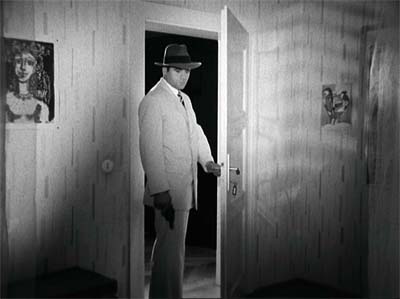
There's a backstory to this man that doesn't really matter. What matters is that he's a killer, and, inevitably, he's being hunted. He's Ricky (Karl Scheydt), a laconic gun for hire whose low, gruff voice languorously warns his victims that they're about to be shot. He seems heartless, almost bored with people, knocks people around and keeps whisky by his side. In the great Rainer Werner Fassbinder's film THE AMERICAN SOLDIER, Ricky slowly makes his way through his old hometown of Munich, Germany, visiting everyone from whores to victims to his mom. There's so little emotion in his face (even his hat often puts his features in shadows) that you wonder whether he even matters. But he seems to. The three men trying to kill him watch his every move. When he asks for a whore at his hotel room, one of the three sends his girlfriend. She takes offense and plans to run away with Ricky, but we question whether this is even a legitimate care, or just a way out. Fassbinder's film is astonishing in its composition. From a long scene of well choreographed cardplayers to striking black and white images intertwined with brisk camera movements as if to wake us up from a daze, the film is inventive and rather beautiful. Also, Fassbinder's backstory to Ricky as an American turned German killer to be killed by Germans is a grand statement on the motives of nations mired in the seemingly stagnant political convictions of Germany despite their insistence to weed out people like Ricky. I admit that portions of Fassbinder's intentional languor dragged a bit, and for all the style and authenticity and homage to American gangster films, the story was perhaps not so important. Regardless, THE AMERICAN SOLDIER is a compelling piece of work.
The American Soldier: ★★★1/2

Wednesday, May 11, 2011

McCabe & Mrs. Miller

McCABE & MRS. MILLER is a film about tone and feel, more than it is about being committed to genre or dialogue. It was directed by Robert Altman, and released in 1971. It's one of Altman's earlier pictures, and yet it feels as if it were a film he was working towards his whole life. It's so defined, so perfect in all of its movements, and feels spontaneous. Altman called it his "anti-western" because he wanted to keep away from all of the usual western movie clichés. The film stars Warren Beatty as McCabe. He's aggressive, possibly an old gunslinger, but now he's trying to make his way in a small Northwestern town where it's always snowing or overcast. He's as unclear as the images, which are gritty, striking, and have the look of "noise" regarding sound. Sometimes when McCabe speaks, you can't tell what he's even saying, as if his words couldn't get past his beard. This could be taken as a fault, but its actually a strength. It reflects the world within the character, and emphasizes that McCabe's actions, his movements are what is important. McCabe makes a name for himself, sets up a saloon that acts as a whorehouse, gets a few whores, and goes steady for a while. Then, Mrs. Miller (Julie Christie) shows up, tells McCabe she knows the business better than him, and they end up working together. This is a depressing film. As McCabe & Mrs. Miller work together as a business rather than lovers, we see a respect that is as deep as love. McCabe is not a smart man, and Mrs. Miller can't do much to help that. This leads to an inevitable fate, which is handled wonderfully. McCABE & MRS. MILLER works as a great western, despite not wanting to be that.
McCabe & Mrs. Miller: ★★★★

Thursday, March 17, 2011

Badlands

Badlands was the first film of Terrence Malick, who, since that debut in 1973 has only made three other films. His fourth is due out this year, and a fifth next year. He seems to want to make up for lost time at an old age. And this every-so-often filmmaking he had been exhibiting was a shame, for, all of his films are of a poetic quality. Badlands is no exception. It begins in a seemingly placid suburban South Dakota where Kit (Martin Sheen) is a charming garbage man who isn't very smart but likes to think he is. Kit begins to court a fifteen year-old named Holly (Sissy Spacek). Even though Kit is a good ten years older than Holly, she is infatuated for she proclaims herself to have no personality and not very pretty. She considers herself lucky to be the polestar of affection for Kit, who she mentions looks like James Dean. Kit and Holly have some wonderful times together, hiding out from the rest of society, who would, without a doubt, frown upon their relationship. This is the theme of Badlands as Kit and Holly stay in their solitary, delusional world away from reality. When they are threatened they attack. Holly's father doesn't like the relationship when he finds out. He doesn't last long, and almost inevitably and out of a fearful and frenzied action, Kit murders him. The duo flee and for some time spend a lyrical life out in the woods, as Holly narrates with beautifully simple and revealing monologue. As they flee from the law, Kit kills more people irrationally and cruelly. Holly never stops him, and thus becomes his accessory. The way that Malick keeps his camera and his directional decisions from condescending or looking down on his characters allows for the film to seep into the delusional world that Kit has created. What is most revealing about the film is the trashiness of its subjects. Their lyricism is submerged into delusion, and what comes out is visceral and absolute--like the shots that ring out of Kit's gun.
Badlands: ★★★★

Thursday, February 17, 2011

The Crazies

It is a truth that becomes more and more evident the more "infection films" I go through. This truth: the first twenty minutes are interesting, and everything after that blows. For, with an infection movie it is the characters that are set up at the beginning, the town, and the filmmaker's personal flare that interests the audience within the first twenty minutes. But after you've run out of things to say about that, the "infection film" becomes like every single one before it. The most frustrating thing about this is that what is supposed to be thrilling becomes boring due to its predictability. Consider the original version of The Crazies (which was remade into absolute trash in 2010). Although the film has George A. Romero behind the camera, it cannot help but deviate into the realm of predictability. The only thing unique about the film is its sadistic nature. Every character is a killer or an asshole. The story revolves around two separate storylines. The first is concerned with a group of military commanders who are attempting to contain a town that has been infected with a biological weapon that turns everyone raving. The second is concerned with a group of possibly unaffected locals who are fleeing from the de-personified soldiers. I say de-personified because the director has attired them in creepy gas masks (so that we don't care when they die). The Crazies is no fun. It's stupid, hopeless, and predictable (so that you can see the further pain before you have to endure it). If only I would have seen the shittiness coming...
The Crazies: ★★

Thursday, February 3, 2011

Picnic at Hanging Rock

Picnic at Hanging Rock is the first real film by Peter Weir, a director who has made many successful films such as: The Truman Show, Master and Commander, and this year's: The Way Back. Picnic at Hanging Rock is not only a very Australian kind of film, but one that seeps with creativity. For, it knows what kind of movie it is and exactly what it wants to convey. It is at times sexual and scary, and at others, outstandingly frustrating. It tells of a mystery, where, in 1900 Australia, a group of girls from a private school go out on Valentine's Day to Hanging Rock (the geological phenomenon nearby the school). At some point during the outing three of the students disappear without a trace, along with their teacher. A week later, a love interest of one of the missing girls returns to Hanging Rock to search. He finds nothing and decides to stay the night, telling his counterpart that he'll be alright. When the friend returns the next day, he discovers the boy bloody and exhausted due to exposure. He finds in his hand lace, and upon searching the crevices of the rock, discovers one of the missing girls. She remembers nothing. As the director takes us through this mystery, suggesting possible rape and murder of the missing with witnesses claiming they saw the teacher in her underwear, and with ominous and creepy music and hidden sexual devices throughout, Picnic at Hanging Rock becomes a mystery film where the mystery will not and should not be solved. We get so much effect from the disappearances, not only on ourselves and our desire to know the truth, but with the characters in the film: who practically go mad with worry and wonder. The film has undertones of impenetrable mystery, and this acts as an allegory for Australia: a place that had been taken from the native people and attempted to be lived in by Europeans. I do not think that Picnic at Hanging Rock is a great film. It can be too slow and it's ideas too impenetrable. But it does exactly what it wants to do, and well. It's cinematography is beautiful, the acting perfect, and most importantly: it brings an audience in with its creepiness.
Picnic at Hanging Rock: ✰✰✰

Sunday, January 30, 2011

Dawn of the Dead

The original Dawn of the Dead begins with a thrilling scene. The military is exterminating the walking dead, and despite all of their machine guns and grit, the sheer numbers of the dead are overpowering them. This scene serves as a precursor to what actually occurs in the film, which is that a group of people gather within a shopping mall, barricade the doors, and live there to escape the evil. Unlike George A. Romero's first zombie flick: Night of the Living Dead, this film has a sense of humor and fun. For a long while, it is. The scenes in the mall are fun, the killings are fun, and the idea that the zombie have flocked to the shopping mall because they remember 'shopping sprees' in marginally amusing. The whole first hour and a half is great fun. And then...the film enters into the territory that all zombie films must inevitably arrive at: sadism, stupidity, and predictability. Sadism: characters we like are eaten from their stomachs to their spinal chords. Stupidity: the characters act in stupid ways and do stupid things. Predictability: one person will escape, the rest are the zombie's midnight snack. What a shame that they all have to end the same way. Why can't someone come up with a way to end a zombie picture on a different note? It's frankly depressing how these films end. That being said, the film is entertaining and (for a while) exceptionally fun.
Dawn of the Dead: ✰✰✰

Thursday, December 30, 2010

Three Days of the Condor

The Three Days of the Condor was directed by Sidney Pollack. Pollack usually makes good films (Tootsie, Out of Africa) and this stands as one of his better ones. It's really just a political thriller, but it's done in a classic tradition that leaves out explosions and leaves it to high tension and the power of the actors to churn out a decent film. Robert Redford is the hero here. He works as a bookworm for the CIA. That means that he reads everything and uses what he reads to come up with ideas for the CIA. The film opens with Redford going out to lunch through the back entrance to his workplace. However, by doing this he doesn't realize that he's evading the outside mercaneries who kill everyone in the building. Redford returns from lunch and to discover the disaster. In a frenzy, he calls up his commanding section officer and is met with terse conversations and shady meeting places. He goes to an alley to meet with his officer and is almost killed. The people from before are trying to kill him, for he's the only one who escaped the previous massacre. He ends up hiding out with a kidnapped girl (Faye Dunaway) and cultivates a relationship with her. The Three Days of the Condor succeeds because of three things. The first is that Robert Redford is a very appealing actor, and his character, who at first attempts to fix everything in the standard hollywood tough way, realizes that its his smarts that will end up saving him. The second thing this film has going for it is the direction, for Sidney Pollack has a very careful hand with the pace of the film, and all the twists and turns. The third thing that makes Three Days of the Condor more than just a standard thriller is that it came out post-Watergate, when the plot didn't really seem so extraordinary. Now, some of the dialogue in the film gets silly, and part of the end really does go off the deep end, but that doesn't keep the movie from being enjoyable and captivating.
The Three Days of the Condor: ★★★1/2

Monday, December 27, 2010

Charlotte's Web

Ahh, here's a good movie. Charlotte's Web is the tale of a pig who was saved from being eaten or killed as a runt by a girl named Fern. His name is Wilbur, and, being a pig, he has to fear that he will one day become the Christmas ham. As his life progresses, he begins to notice the girl who saved him (Fern) is starting to become an adult and she's slowly forgetting about him. Wilbur fears that this might result in his death, for he will have no protector. However, Wilbur is granted kindness once again by a spider named Charlotte who lives above his pen. They scheme and scheme and Charlotte comes up with a plan to save Wilbur. Using her web, Charlotte writes words that gratify Wilbur. The entire town is amazed (at the pig) and they come from miles around to view him. The end of the story is sad, but puts a close to the fable, which is told so warmly by E.B. White in his book, and is translated very well to a fine looking animated movie. It's not great, but it follows the book to well to not be good. It's got some good qualities to it, it's nice and slow and doesn't demand stupid jokes or bursts of action to tell it's story.
Charlotte's Web: ★★★

Sunday, December 19, 2010

Goin' South

This movie was directed by Jack Nicholson (one of the best actors alive) and he stars in it. It's about an outlaw who becomes the wife (and essentially the bitch to) the woman who saves him from execution. She makes him work in her gold mine that produces no gold (is it safe to assume or divulge that it will see a brighter day?) and tend to anything else she can. It's supposed to be a comedy. But the whole idea is kind of stupid, so it's just not funny. But they [the filmmakers] keep on plowing this idea into our heads. Isn't it hilarious that the outlaw is really dumb and dirty and the woman is very refined! How many times have we not see that before! There are some interesting lines here and there in Goin' South and some worthwhile supporting performances (most notably with John Belushi) but it just keeps on getting more boring, more predictable and stupider. It sucks.
Goin' South: ★★